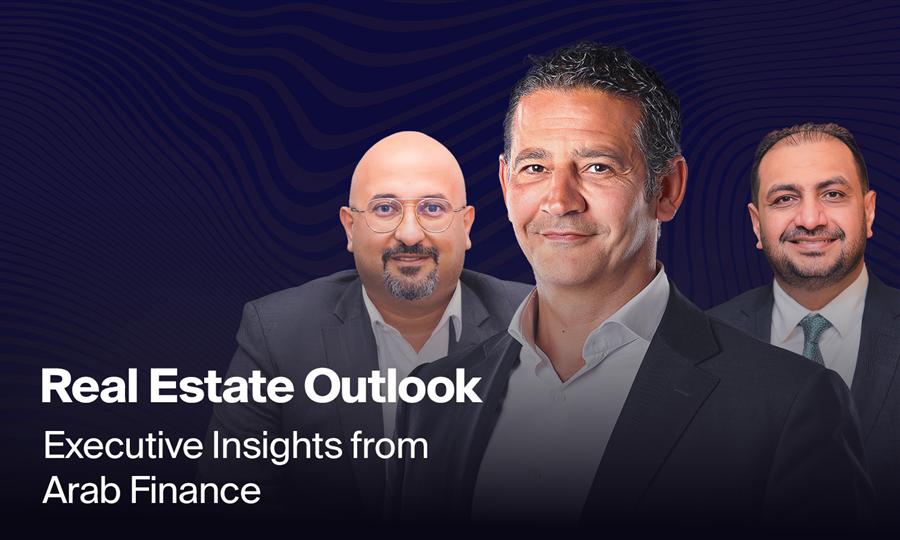
2026 Real Estate Outlook: Executive Insights from Arab Finance
Throughout 2026, Egypt’s real estate market has reached a critical structural inflection point. On one hand, nominal sales growth and total sector valuations have expanded dramatically, fueled by an influx of Gulf Cooperation Council (GCC) capital, currency movements, and persistent domestic cost-push inflation. On the other hand, a widening gap between property selling prices and end-user purchasing power has triggered an intense debate regarding valuation accuracy, project feasibility, and long-term sustainability.
To provide a comprehensive analysis of the forces reshaping the Egyptian property market, Arab Finance analyzed a series of executive interviews on its platform featuring three prominent industry leaders: Mohamed Abdel Gawad, Chairman and CEO of Vantage, Bassel El Serafy, Global CEO of Adeer International, and Karim Malash, Chairman and CEO of M squared.
Drawing on these key conversations, this analysis synthesizes into a comprehensive strategic assessment of the 2026 Egyptian property market. By mapping these executive perspectives across three core dimensions: data and valuation transparency, cross-border capital and regional alliances, and execution and operational quality, this report outlines the critical drivers reshaping property prices, developer priorities, and investment strategies in Egypt today.
Macroeconomics, Cost-Push Inflation, and Data-Driven Transparency
As highlighted in Arab Finance's published interview with Vantage Developments, the Egyptian real estate sector entered 2026 following sustained cost pressures. Data from the Official Egyptian Real Estate Platform indicates that residential property prices surged by approximately 30.4% year-on-year (YoY) as of April 2025, driven by raw material inflation (steel, cement, finishings), transport costs, labor, and depreciation of the Egyptian pound.
In his interview with Arab Finance, Mohamed Abdel Gawad observes that pricing real estate in 2026 is a dynamic, multi-variable equation. Pricing strategies can no longer rely on static historical assumptions or simple competitor benchmarks; developers must proactively model shifting cost structures throughout the multi-year development lifecycle.
A recurring theme across industry discussions is the absence of a unified benchmark for transaction values. Fragmented data forces developers, buyers, and funds to rely on inconsistent information, feeding speculative mispricing. Abdel Gawad clarifies that, in the overwhelming majority of cases, elevated selling prices accurately reflect real development input costs. While isolated liquidity-distressed developers may market units below cost to satisfy immediate obligations, evaluating the broader market through these edge cases creates a distorted picture. Sustainable pricing requires balancing total development expense—land, materials, labor, and financing—against realistic market absorption rates.
Market Intelligence, National Price Indices, and AI Integration
A structural challenge in Egypt's real estate market has been the absence of a unified, objective benchmark to track transaction values. Information differences often force developers, buyers, and institutional funds to rely on fragmented data, feeding speculative mispricing.
In his Arab Finance interview, Abdel Gawad strongly advocates for the creation of a comprehensive National Real Estate Price Index. To accurately reflect ground realities, this index must aggregate: micro-market selling price movements by location and asset type; actual transaction volumes and absorption rates; shifting construction input costs, labor, and materials; broader demographic trends and regional urban expansion data.
Complementing national data infrastructure is the enterprise adoption of artificial intelligence (AI) and predictive data analytics. Developers like Vantage Developments utilize AI models to process complex economic variables, track supply-demand shifts, and dynamically price inventory. Beyond pricing, PropTech integration enhances the entire real estate value chain, optimizing building management systems, including HVAC, smart lighting, and digital resident platforms, as seen in projects like M Signature in New Cairo, which operates as Egypt's first homegrown branded serviced residence.
Cross-Border Capital Flows, Strategic Alliances, and Micro-Market Hotspots
Egypt’s real estate market has consolidated its role as an asset-backed hedge and growth driver in the MENA region. According to Ken Research’s “Egypt Real Estate Market Share, Companies & Trends Report”, the sector’s total market size reached $137 billion in 2025, expanding by 11.4% YoY, while gross transaction value across primary developer sales reached EGP 3.03 trillion. Following the exceptional, landmark Ras El-Hekma transaction in fiscal year (FY) 2023/2024, net foreign direct investment (FDI) inflows, as reported by the Central Bank of Egypt (CBE), stabilized at $12.2 billion in FY 2024/2025—underwritten by sustained GCC institutional funds and private family offices.
In his feature on Arab Finance, Bassel El Serafy, Global CEO of Adeer International, highlighted the core structural market fundamentals drawing GCC institutional investors to Egypt’s real estate sector. The market is projected to expand at a compound annual growth rate (CAGR) of 10.9% between 2024 and 2029 to top $33 billion. This growth is underpinned by a young, rapidly urbanizing demographic that drives organic, long-term demand over speculative trading. The market’s underlying strength is further reinforced by government regulatory reforms, including streamlined tax frameworks, investor incentives, and updated legal procedures, that give international institutional funds necessary clarity.
Additionally, recent currency realignments offer GCC investors an advantageous FX entry point to acquire prime, tier-one assets at compelling valuations relative to broader regional benchmarks.
Institutional Cross-Border Alliances
Rather than pursuing direct land acquisitions, regional investors increasingly partner with established domestic developers. The PARAGON | Adeer joint venture, which brings together Paragon Developments’ expertise in regenerative design and Adeer International, the international arm of Saudi Arabia's Sumou Investment, illustrates this trend as detailed on Arab Finance.
This strategic alliance combines Saudi financial discipline and global governance with local execution and design innovation. Anchored by Sumou Investment’s institutional backing, the joint venture is developing Sumou Boulevard in Mostakbal City, an EGP 70 billion investment expected to generate EGP 100 billion in sales revenues across 500,000 square meters.
Mostakbal City has emerged as an example of these cross-border partnerships that can transform the real estate sector in Egypt.
Execution Speed, Operational Readiness, and Year-Round Lifestyle Yield
Following periods of intense pre-sales activity, Egypt's market is transitioning toward execution, delivery, and operational readiness. Buyers and investors examine developer balance sheets, construction timelines, and track records before committing capital.
To insulate projects from inflationary shocks, developers emphasize structured procurement, value engineering during design, and fixed-scope delivery timelines to control costs. Digitized workflows and governance frameworks further enhance transparency, reinforcing buyers’ confidence in delivery schedules. These operational strategies reflect a sector-wide pivot from expansionary launches to disciplined execution.
Karim Malash, Chairman and CEO of M squared, gave an example of this model with M squared’s "Uplift" campaign, an enterprise-wide initiative designed to digitize workflows, enforce strict corporate governance, and coordinate development, commercial, and construction teams.
Extending Seasonality: Year-Round Lifestyle Monetization
Another shift explored across Arab Finance's coverage is the evolution of coastal developments from seasonal summer getaways into multi-season, operational destinations. Demand on the North Coast, specifically in high-growth corridors like Ras Alhekma, is moving toward year-round utility.
Through initiatives like Yalla Sahel and projects like Masyaf Ras Alhekma, developers are integrating boutique hospitality, sports, wellness, retail, and dining directly into master plans. Collaborating with international brands enables developers to generate recurring rental yields, sustain high off-season occupancy, and preserve capital appreciation for homeowners.
What the Interviews Say
For developers, the imperative is to transition from static pricing to AI-driven dynamic models rooted in predictive cost analysis. Capital should be reallocated toward construction completion and operational infrastructure rather than speculative launches. Cross-border joint ventures provide a pathway to pair local execution with institutional balance sheets, ensuring resilience against macro volatility.
For investors, the priority is to evaluate operational delivery by focusing on developers with proven track records, completed projects, and clear execution commitments. Capital should be directed toward master-planned hotspots such as Mostakbal City and Ras Alhekma, which benefit from infrastructure investments and year-round amenities. Assessing recurring yield potential is equally critical, with integrated developments backed by professional hospitality management offering reliable post-handover income streams.
For policymakers, the challenge is to enhance transparency and eliminate mispricing by establishing a standardized national price index that consolidates data collection across developers, brokerages, and public registries. Accelerating digital transformation through PropTech integration and streamlined institutional investment workflows will help sustain foreign direct investment and bolster long-term market stability. Reinforcing governance frameworks will further ensure that speculative distortions do not undermine sustainable growth.
The analytical synthesis of Arab Finance’s published 2026 Real Estate Interview Series confirms that Egypt's property market is maturing beyond speculative expansion. While macro volatility and inflation present challenges, they have accelerated necessary structural upgrades across the sector. Developers who rely on data analytics, partner with institutional GCC capital, and deliver operational, lifestyle-rich communities are establishing the operational blueprint for real estate growth in Egypt.