Recently, Moody’s downgraded Egypt’s credit rating. This was not the first agency to do so, as Fitch Ratings announced in May the downgrading of Egypt’s credit rating. Moreover, Standard and Poor’s Global (S&P Global) revised Egypt’s outlook from stable to negative.
In this Factsheet, we will discover with you the backscene details of these announcements and the factors behind the downgrade. Yet, first, we will start our Factsheet by explaining what a credit rating means.
- A credit rating for a country is an assessment of the risk involved when investing or lending money to a particular government. In other words, it measures a government’s creditworthiness in general terms or with respect to a particular debt or financial obligation.
- In April, the American credit rating agency S&P Global affirmed its “B” rating for long- and short-term foreign and local currency in Egypt. However, the agency revised the country’s outlook from stable to negative.
- The rating was based on the agency’s expectations that the country’s high external finance needs would be met mainly by multilateral and bilateral lenders. However, the negative outlook came as the agency sees that the policy measures implemented by the government concerning stabilizing the exchange rate are delayed and insufficient.
- In May, and for the first time since 2013, Fitch Ratings downgraded Egypt’s credit rating from “B+” to “B”, while maintaining a negative outlook for the Egyptian economy.
- Fitch based its decision on the increasing external financing risk given the high external financing requirements and the constrained external financing conditions, along with the uncertainty of investors concerning the economy’s ability to attract foreign currency inflows into the market.
- Moody’s, for the second time this year, downgraded the credit rating from “B3” to “Caa1”, which means high credit risks, however, with a stable outlook. The agency explained that the downgrade is due to the deteriorating affordability of the country to bear external debts, in addition to the shortage of foreign currency inflows, which affects its ability to pay debt service.
- Moody’s upgrade of Egypt’s outlook from negative to stable was backed by the government’s fiscal reforms, the continuation of selling state assets to provide foreign currency, the financing provided by Gulf countries, and the agency’s expectations that Egypt will receive future batches from the International Monetary Fund’s (IMF) loan.
- The correction of the official exchange rates that started in February 2022, in addition to other global events, pushed the headline annual inflation rate in Egypt to jump in 2023, from 25.8% in January to 38% in September. To manage the increasing inflation rates, the Central Bank of Egypt’s (CBE) Monetary Policy Committee (MPC) increased the interest rates by 300 basis points since the beginning of the year, which puts further pressure on the country’s debt.
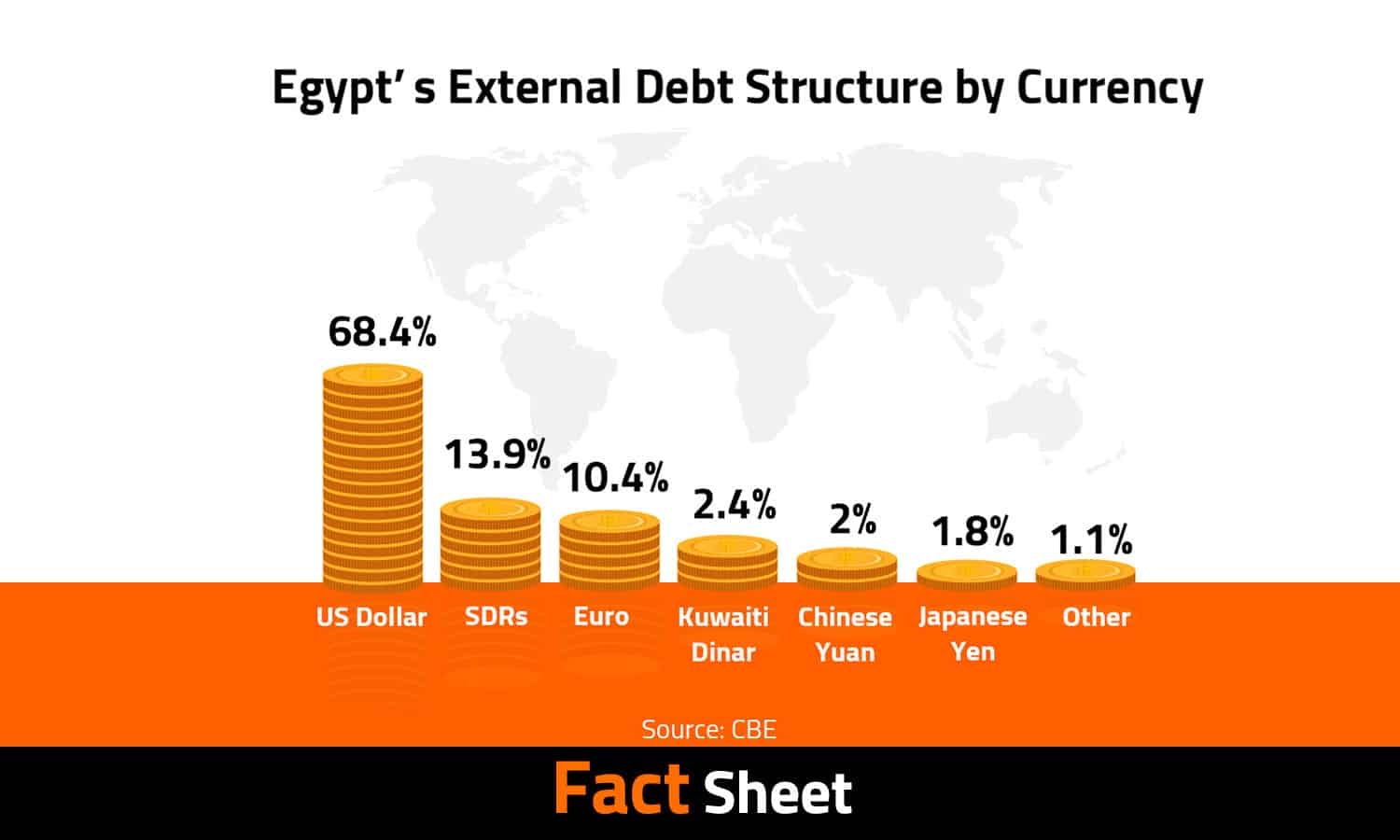
- Egypt’s external debt reached $17 billion in March 2023 (38.5% of GDP). Egypt is obligated to pay $29.23 billion in installments and debt service in 2024, of which $14.59 billion will be paid off in the first half of the year and $14.6 billion in the second half.
By: Amina Hussein
Related News