Arab Finance: With the Investment Migration Council reporting a significant rise in demand for alternative residency, global mobility has transitioned from a luxury to a critical "business insurance policy" for the modern entrepreneur. In Egypt, this shift is increasingly visible as investors look toward Caribbean jurisdictions like Dominica and St. Kitts and Nevis, for visa-free access to over 140 destinations, or to European Golden Visas in Greece and Portugal to secure long-term asset protection and education for their families. As the Egyptian government continues to refine its own Citizenship by Investment (CBI) programs to attract foreign capital, the local private sector is witnessing a recalibration of how wealth is structured across borders.
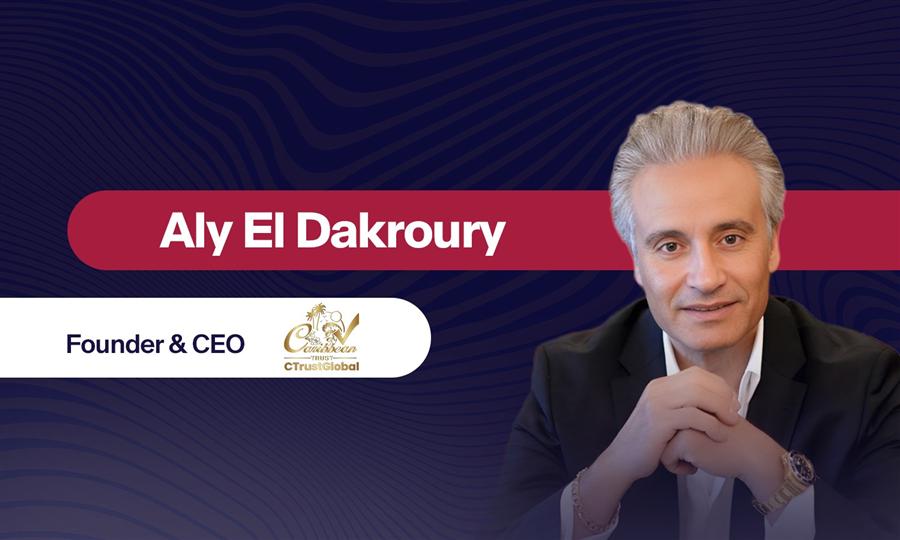
In this interview, we sit down with Aly El Dakroury, Founder and CEO of CTrustGlobal and Executive Director of ELDARY Holding, to discuss a "360-degree" investment strategy that bridges the gap between mobility and real-sector growth. El Dakroury explores how the synergy between his two entities allows Egyptian investors to transform from local players into globally integrated decision-makers. He shares his perspective on the evolving landscape of Caribbean investment, the necessity of institutionalizing family offices for international scaling, and why structured global exposure is no longer optional in today's volatile economic environment.
1- Your career reflects a 30-year evolution across traditional sectors. How do you define the common thread between CTrustGlobal and ELDARY Holding, and how does this dual-sector approach allow you to navigate the complexities of today’s international markets?
The common thread across both entities is a unified approach to managing opportunity and risk on a global scale.
While CTrustGlobal focuses on mobility and access to international markets, ELDARY Holding focuses on building tangible, real-sector investments. Together, they form a complementary structure that allows us to balance flexibility with long-term asset creation, enabling us to navigate complex and evolving global markets with confidence.
2-With a footprint spanning the Caribbean, Europe, and the Middle East, you bridge regional capital with global opportunities. How would you describe the core mission of your group, and why is now the critical moment for Egyptian investors to look toward the integrated model you have built?
Our mission is to transform investors from being locally positioned into globally integrated decision-makers.
Today’s environment no longer supports reliance on a single market. With increasing global volatility, Egyptian investors are at a pivotal moment at which diversification, mobility, and structured international exposure are no longer optional but necessary for sustainable growth.
3-You lead two distinct yet complementary entities: CTrustGlobal for mobility and ELDARY Holding for industrial development. Could you elaborate on how these organizations work together to provide a '360-degree' investment strategy for high-net-worth individuals in the MENA region?
We approach investment as a system, not as a set of isolated services. CTrustGlobal secures the investor’s ability to move, operate, and access international opportunities, while ELDARY Holding focuses on deploying capital into real, productive sectors. This creates a full-cycle strategy where mobility and investment work together to deliver both protection and growth.
4-How is CTrustGlobal repositioning global mobility as a critical "business insurance policy" for MENA-based entrepreneurs?
Global mobility today has evolved into a strategic necessity. Second citizenship or residency provides entrepreneurs with the ability to operate across multiple jurisdictions, access financial systems, and respond quickly to changes. It is not about luxury, but about preparedness and continuity in an unpredictable global landscape.
5-Egypt has introduced its own citizenship-by-investment pathways. From your perspective, how does the Egyptian program compare to established models in the Caribbean or Europe in terms of attracting foreign direct investment (FDI)?
Egypt’s program represents an important step forward, reflecting the country’s openness to attracting foreign investment.
However, compared to more mature programs in the Caribbean or parts of Europe, there is still room for development in terms of speed, clarity, and consistency. These factors are critical to building long-term investor confidence and attracting sustained capital inflows.
6-You have extensive experience in markets like Dominica and the wider Caribbean. What are the specific tax and asset-protection advantages that these jurisdictions offer to Egyptian investors looking to internationalize their wealth?
Caribbean jurisdictions offer a combination of flexibility and stability that appeals to globally minded investors.
They provide efficient legal frameworks, ease of asset movement, and predictable regulatory environments. For investors seeking to internationalize their wealth, these elements are essential in reducing concentration risk and ensuring long-term asset protection.
7-With shifting regulations in the EU (such as the phasing out of certain Golden Visas), where should investors be looking in 2026 to ensure long-term residency security and visa-free access to global markets?
The investment landscape is shifting toward stability and reliability rather than short-term appeal.
With regulatory changes affecting some European residency programs, investors are increasingly prioritizing jurisdictions with proven track records, transparent regulations, and strong international acceptance. The focus is no longer on access alone, but on the sustainability of that access.
8-How are you evolving your tourism and hotel projects to meet the demands of "sustainable luxury"? Is ELDARY Holding looking to bring international hospitality brands into the Egyptian market?
The concept of luxury has evolved significantly. Today’s market demands not only high standards but also meaningful experiences and sustainable value. Our approach focuses on delivering quality-driven projects that combine operational excellence with long-term viability, while also exploring opportunities to collaborate with established international hospitality brands.
9-How is ELDARY Holding navigating supply chain costs while maintaining the international quality standards you’ve established in Europe and Canada?
The current challenges in construction and supply chains require disciplined and proactive management.
We address this through strategic planning, diversified sourcing, and strict cost control, while maintaining the quality benchmarks we have established across our international operations. Protecting our standards remains a top priority regardless of market fluctuations.
10-How do you advise Egyptian clients to diversify their assets abroad without weakening their local positions?
Effective diversification is not about shifting away from the local market, but about expanding beyond it.
We advise clients to maintain a strong domestic foundation while strategically allocating assets internationally. This balanced approach ensures resilience without weakening their core position.
11-What is the one thing the Egyptian private sector needs to do fundamentally to attract more institutional-grade partners from the Caribbean and North American markets?
The key to attracting institutional-grade partners lies in building trust at a structural level.
International investors prioritize governance, transparency, and consistency. Strengthening these elements within the private sector is essential for positioning Egypt as a reliable and attractive destination for long-term partnerships.
12-Finally, what is the biggest "management gap" you see in MENA-based family offices when they attempt to scale into international markets?
One of the most significant challenges faced by family offices in the region is the transition from family-driven management to institutional frameworks.
While many have achieved strong local success, scaling internationally requires structured governance, clear decision-making processes, and long-term strategic planning. Without these elements, expansion beyond local markets becomes increasingly difficult.