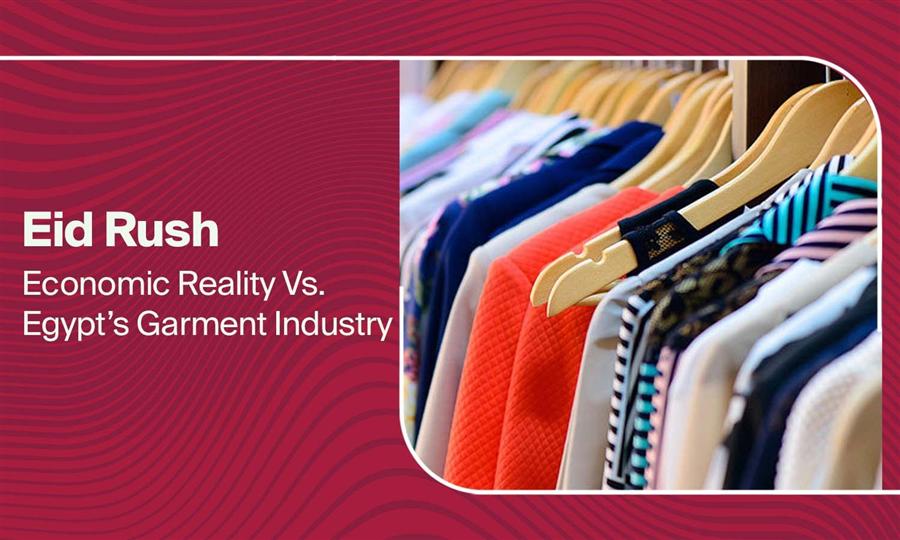
Eid El-Fitr sparks an annual "Eid clothes" shopping frenzy that consistently boosts production and retail sales, demonstrating how Egypt's garment industry thrives on tradition. Yet beneath this seasonal vibrancy lie growing pressures from inflation, currency depreciation, and geopolitical unrest.
Despite these domestic challenges, the industry has remained resilient, with growth in exports in 2025 that underscores its long-term potential.
Economic Pressures on the Garment Sector
Religious and cultural celebrations, especially Eid El-Fitr, remain among the most powerful demand drivers for Egypt’s garment sector. The tradition of purchasing “Eid clothes” reliably boosts retail turnover and factory output.
In March 2025, the wearing apparel production index surged by 33.36% year on year and 5.39% month on month as Egyptians prepared for Eid, according to the Central Agency for Public Mobilization and Statistics’ (CAPMAS) monthly bulletin for manufacturing and extractive industries.
This seasonal spike reflects deeply rooted consumer behavior and underscores the sector’s sensitivity to cultural cycles. Manufacturers often ramp up production weeks in advance in anticipation of strong demand for festive apparel.
In this regard, Mohamed Shamsi, Co-Founder of MYS Fashion Company, explains to Arab Finance: “As a company specializing in shirt manufacturing, we have consistently seen strong seasonal demand around Eid. From our experience, Eid shopping remains a very important retail moment each year, and demand for festive clothing is still very much present.”
Inflation and Geopolitical Challenges
By the end of 2025, however, the picture had shifted. The apparel production index recorded a 1.82% annual decline in November 2025 and a 5.4% monthly decrease, according to data by the CAPMAS.
Eman Taher Sakr, an assistant lecturer in the Textile Engineering Department at the BUC’s Faculty of Applied Arts, explains: “When the Egyptian pound depreciates, the local-currency cost of imported inputs rises immediately, increasing the unit cost of finished garments.”
She points out that many garment manufacturers rely on imported raw materials and production inputs, including fabrics and yarns, dyes, chemicals, auxiliaries, trims and accessories, machinery spare parts, needles, attachments, and technical consumables. Inflation raises electricity, fuel, freight, wages, and maintenance costs, tightening margins across the value chain.
On the demand side, inflation shifts household budgets toward essentials, causing consumers to delay festive purchases, buy fewer items, or switch to lower-priced brands. Retailers, in turn, face higher levels of unsold stock and deeper markdowns, further squeezing profitability.
Sakr adds that “inflation-driven demand weakness can impact the garment value chain in several ways. Retailers may hold more unsold seasonal stock, increasing markdowns. Discounting pressures reduce profitability, especially when input costs are simultaneously increasing. Volatility also makes planning harder, while mis-forecasting increases overproduction and working-capital stress.”
Meanwhile, Shamsi says, “The cost of imported fabrics and accessories has impacted production decisions. With the escalation of global tensions and the war, we saw a sudden spike in the USD-EGP exchange rate, which made importing raw materials significantly more difficult and unpredictable.”
Using locally produced materials can mitigate this challenge. Shamsi notes: “Fortunately, since 2020, we have made a strategic decision not to rely on imported materials for products sold to our local clients. This has helped protect us from currency volatility, as we are able to offset foreign exchange pressures through our export business instead.”
Beyond domestic economic pressures, global disruptions pose additional risks. Utkan Uluçay, a PhD holder and logistics and supply chain management expert, warns that Egypt’s reliance on “cheap production and easy logistics” is no longer sufficient as a competitive advantage.
“Let us look around Egypt. There is an ongoing war in the Gaza Strip with Israel and another conflict between Israel, the US, and Iran. These may threaten the sourcing of raw materials from Israel, which is a prerequisite for duty-free customs to the US through the Qualifying Industrial Zone (QIZ),” he adds.
“Moreover, sourcing fabrics and trims from Bangladesh is becoming risky as sea and air freight continue to rise. This may end the QIZ business," he points out.
He further highlights the risks posed by Houthi activity in the Red Sea, which "increases the freight costs and lead times for Never Out of Stock (NOOS) items in European markets. Fast delivery, compliant small replenishment orders will soon be available. These orders will not match current garment factory setups in Egypt, which are ideal for large orders with long lead times and QIZ-backed businesses.”
Additionally, “the Iran War and the blockade of the Strait of Hormuz could make sourcing polyester fabrics and trims difficult in the future. Almost 60% of clothing materials and trims, such as shirt buttons, are based on polyester fibers. Recycling or alternative fibers my become more favorable in the near future. Egypt has very limited recycling polyester capacity, so cotton could be a viable option for the country,” Uluçay adds to Arab Finance.
Driving Competitive Sector and Boosting Exports
Despite domestic headwinds, Egypt’s apparel exports continued to expand in 2025. According to the Apparel Export Council of Egypt, exports reached $3.394 billion in 2025, 20% up from $2.834 billion in 2024.
This resilience aligns with observations by Dalia Rady, Senior Advisor for Trade Policy and Industrial Competitiveness at the Textile and Garment Sector. She notes that “Egypt’s garment and textile sector possesses strong growth potential, supported by its strategic location, competitive production economics, and long-standing manufacturing capabilities.”
Rady also highlights the role of institutional support, noting that the Export Council actively works “to raise export value and open new markets, with emphasis on key destinations such as the US.” The council also plays an active role in “international partnerships by organizing forums and meetings with global brands to position Egypt more strongly within global apparel supply chains.”
Currency depreciation, while painful for importers, can enhance export competitiveness. As Sakr notes, it makes Egypt “more cost-attractive in foreign-currency terms for export production.”
Accordingly, Egypt’s apparel industry continues to demonstrate resilience, and with the right policy mix, it can boost its competitive advantage. “To remain competitive in a high-inflation environment, companies often adopt a set of operational and commercial adjustments,” Sakr points out.
These measures include maintaining aesthetics while reducing cost through fabric selection, trims simplification, and efficient patterning; reducing stock keeping units (SKUs) and focusing on best-seller items with faster replenishment models; and increasing flexibility to react to real demand signals rather than building speculative inventory. Companies also seek to reduce defects, returns, and rework to protect margins, while placing greater emphasis on exports to offset softer domestic discretionary demand, according to Sakr.
Additionally, Rady explains to Arab Finance that "institutional support is a critical pillar for strengthening competitiveness, especially when global buyers prioritize reliability, compliance, and supply-chain transparency."
Meanwhile, Shamsi illustrates that policies that support export-driven manufacturers could significantly strengthen Egypt’s garment sector against global pressures. “This could include faster export rebate programs, easier access to foreign currency for importing essential raw materials, and incentives that encourage investment in modern machinery and technology.”
“Supporting local brands in international marketing and trade exhibitions could also help Egyptian trading companies expand their global reach,” he adds.
Sustainability is also a key for the Egyptian apparel sector to flourish. Uluçay notes that businesses need to adopt sustainable strategies nowadays. “This means being sustainable environmentally, socially, and in terms of governance; reliable through on-time and in-full shipments; flexible with small quantities, several styles, short lead times, fast sampling, and digital existence; and secure from the Middle East crisis and logistic disruptions by investing in human capital to ensure future business.”
With centuries of cultural tradition intertwined with the harsh realities of a volatile global economy, Egypt’s garment industry now finds itself at a crucial crossroads. The twin pressures of inflation and geopolitical instability are reshaping the broader industrial landscape, even as the seasonal surge around Eid El-Fitr continues to offer domestic retailers a reliable boost in demand.
To turn these difficulties into long-term stability, the industry must change from a "cheap production" model to one centered on strategic agility.
By Sarah Samir