The world’s food security has been threatened since the Russian-Ukrainian War broke out in early 2022. As a consequence, the global prices of all strategic grains and commodities soared. This was combined with the recent decision of India to ban its rice exports, which led the international rice prices in July to the highest levels in 11 years.
In this Factsheet, we will introduce a brief background on the main driving factors of this crisis while highlighting Egypt’s key facts concerning one of its strategic commodities.
- In July, the Indian government decided to ban the exports of non-basmati rice to stabilize the local prices as they tended to move higher.
- The rice price was pushed by the El Niño phenomenon, which is a climate pattern that causes unusual warming of the surface of the waters in the Pacific Ocean. Nearly 90% of the water-intensive crops are produced in Asia, where this phenomenon caused the rainfall to be less than usual and damaged the crops.
- In 2022, India accounted for more than 40% of the global rice exports, with around 55.4 million tons exported from India to more than 140 countries, including Egypt.
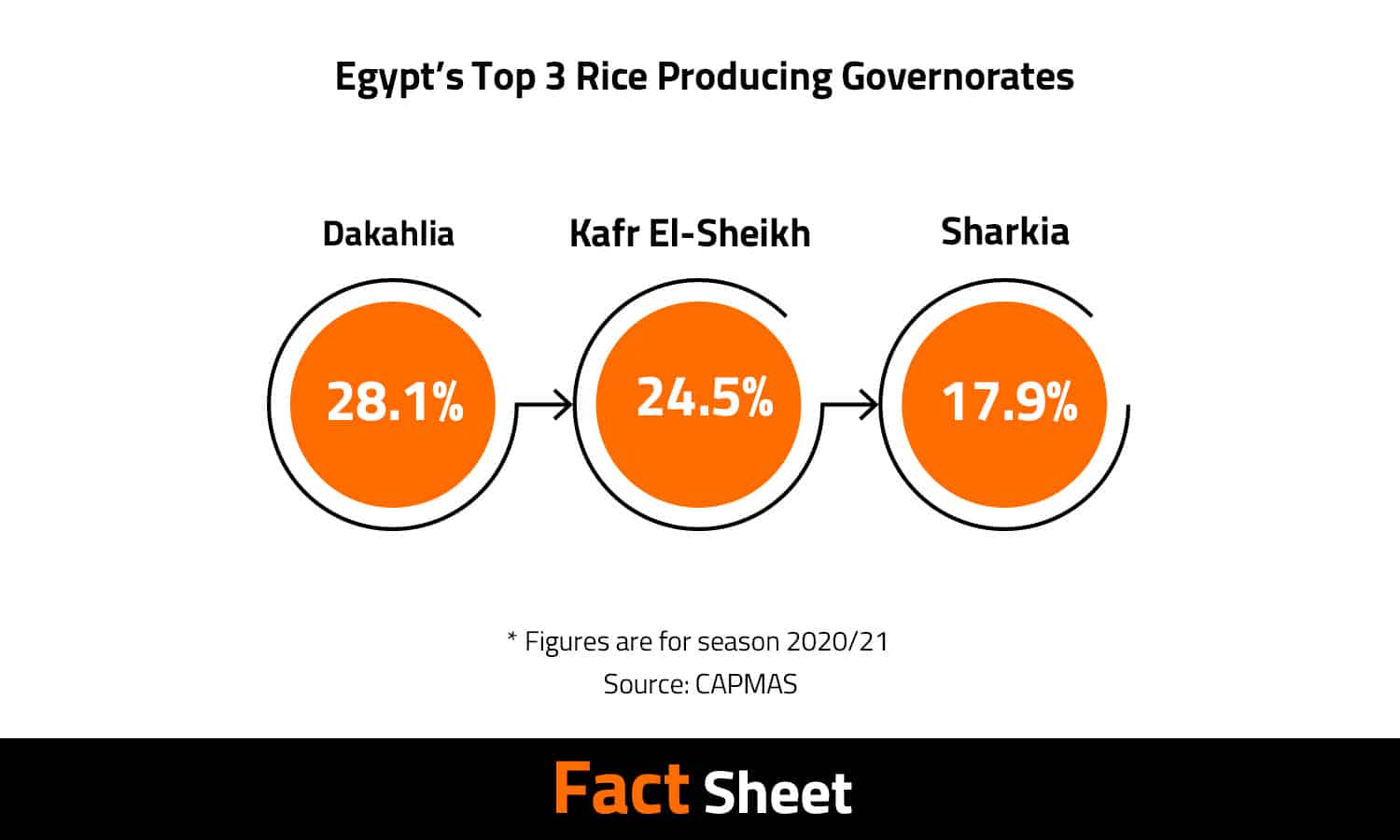
- In Egypt, the rice cultivated land area reached 1.1 million feddan in 2020/21, which represented 6.7% of Egypt’s total cultivated area. It is worth mentioning that the cultivated area of rice shrank by 7% year on year (YoY).
- The latest data released by the Central Agency for Public Mobilization and Statistics (CAPMAS) showed that the production of rice in Egypt fell from 4.4 million tons in 2019/20 to 4.2 million tons in the following year.
- The fall in production was mainly due to the reduction in the cultivated area. As rice is a water-intensive crop, the government has been working to regulate its cultivation to manage water consumption.
- The Food and Agriculture Organization (FAO) of the United Nation (UN) estimated that Egypt’s total production of rice would hit 3.7 million tons in the 2022/23 season and would increase to 3.9 million tons in the following season.
- In 2022, Egypt was able to achieve self-sufficiency in rice production. In addition, Egypt ranked 14th among the world’s top rice consuming countries. The data showed that Egyptians consumed 4 million tons of rice. China, India, and Bangladesh came on top of the list with consumption of 155, 112.5, and 37.6 tons,
- In 2022, Egypt’s imports of rice increased by 71% YoY to $106.1 million. India acquired 87% of Egypt’s rice imports. Egypt’s rice imports represented 0.3% of the global imports and Egypt came in the 65th place among global importers.
- In 2022, Egypt’s rice export remarkably increased by 506.5%, recording a value of $11.3 million. This made Egypt the world’s 51st rice exporter, with a share of 0.04%.
- In August, the Egyptian government announced that rice reserves are sufficient to fulfill consumption demands for 3.3 months.
By: Amina Hussein
Related News