In 2016, Egypt launched an economic reform program in cooperation with the International Monetary Fund (IMF), securing a $12 billion loan to support economic stabilization and address key macroeconomic imbalances. Since then, successive financing programs and reviews have taken place amid continued economic pressures, making Egypt one of the IMF’s largest debtors.
This factsheet traces the development of Egypt’s relationship with the IMF over the past decade, covering its major financing programs and related reforms, including the recent completion of the seventh review and the approval of a $1.8 billion disbursement.
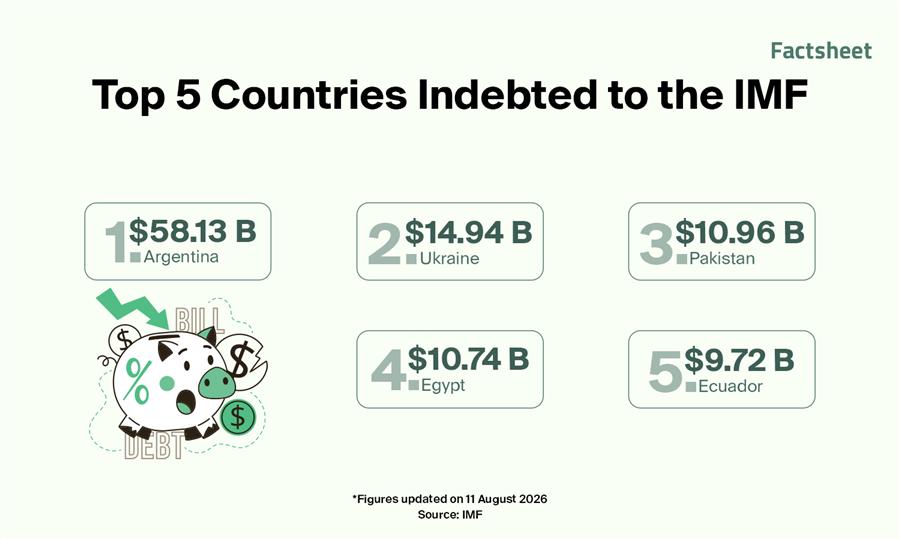
- According to the latest data published by the IMF on August 11, Egypt ranks fourth among the IMF’s largest borrowers, following Argentina, Ukraine, and Pakistan, with outstanding credit of approximately $10.74 billion, accounting for 6% of the fund’s total credit outstanding. Egypt’s position reflects the scale of its successive borrowing programs with the IMF over the past decade.
- Since 2016, Egypt has drawn around $25.3 billion from the IMF through successive financing programs. The first IMF-backed reform program, launched in 2016, provided $12 billion under the Extended Fund Facility (EFF). During the COVID-19 pandemic, Egypt received $2.8 billion in emergency financing and a $5.2 billion one-year facility. The current program was initially approved at $3 billion in 2022 before being expanded to $8 billion in March 2024, alongside a separate $1.3 billion Resilience and Sustainability Facility (RSF).
- IMF-supported programs have been accompanied by major economic reforms, including the adoption of a more flexible exchange-rate regime, monetary tightening to contain inflation, fiscal consolidation, and reforms to energy subsidy system. The 2016 program also introduced the value-added tax (VAT) and supported measures to strengthen social protection and reduce the fiscal deficit.
- Under the current program, Egypt has also committed to reducing the state’s economic footprint and increasing private-sector participation. Measures have included advancing the state-asset divestment program, strengthening state-owned enterprise governance, improving tax administration, broadening the tax base, and developing a more comprehensive debt-management strategy.
- The latest review highlights continued progress in macroeconomic stabilization. Following completion of the seventh EFF review and second RSF review, Egypt received about $1.78 billion, including a larger-than-expected RSF component after completing an additional reform measure.
By: Amina Hussein
Related News