With the approach of Eid El-Fitr, sugar consumption in Egypt typically rises as households prepare traditional sweets, particularly cookies (kahk). At the same time, the Egyptian government has extended its ban on sugar imports for trading purposes until the end of April 2026. The decision, circulated by the Egyptian Customs Authority (ECA) through Import Circular No.7 of 2026, aims to protect domestic industry, regulate the local market, and support strategic reserves amid rising domestic production.
In this Factsheet, we provide background on the import ban and outline key trends in Egypt’s sugar production, consumption, exports, and imports.
- Egypt began banning the import of sugar for commercial purposes on November 16th, 2025, and the measure was extended in March 2026. The decision followed a rise in national sugar output during the season ending in August 2025, driven by an increase of nearly 34% in sugar beet production. The policy aims to protect local producers from potential losses caused by excessive imports that exceed domestic market needs. At the same time, the government maintained restrictions on sugar exports to preserve market stability, allowing exports only from quantities exceeding the country’s requirements.
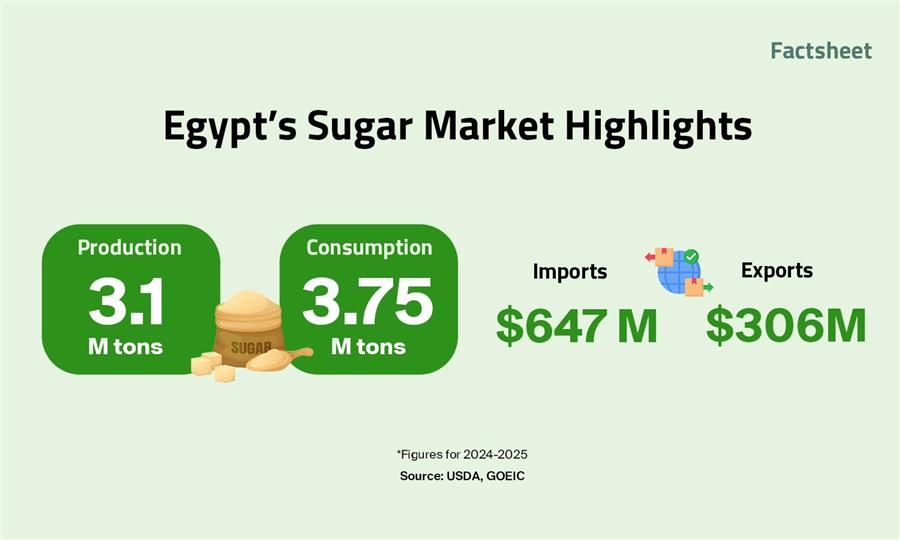
- In the 2024/2025 season, Egypt’s raw sugar production reached 3.1 million tons, representing an annual increase of 19.2%. Sugar produced from sugar beet accounted for 77.4% of total production, while 22.6% came from sugarcane. Egypt’s sugar production is expected to increase slightly in 2025/2026 by 2.6% year on year (YoY) to 3.18 million tons.
- Egypt has 16 sugar processing companies. Eight companies process sugarcane, and all are state-run. Of the eight sugar beet processors, five are private, and the rest are state-run companies.
- In 2024/2025, Egypt’s domestic sugar consumption reached 3.75 million tons, which created a market gap filled by imports of around 1.26 million tons. Consumption is expected to reach 3.85 million tons in 2025/2026. Growing domestic supply is expected to narrow the market gap to 1.06 million tons.
- In 2025, Egypt’s sugar imports reached $647 million, representing a 36.5% YoY fall. Around 95% of these imports came from Brazil alone. The suppliers list also included the European Union (EU), with imports of around $20 million.
- Despite being a net sugar importer, Egypt exports part of its production to the rest of the world. In 2025, Egypt’s sugar exports reached $306 million. Lebanon was the top importer, with a share of 35%, followed by Sudan with 23% and Kenya with 11.4%.
By: Amina Hussein
Related News