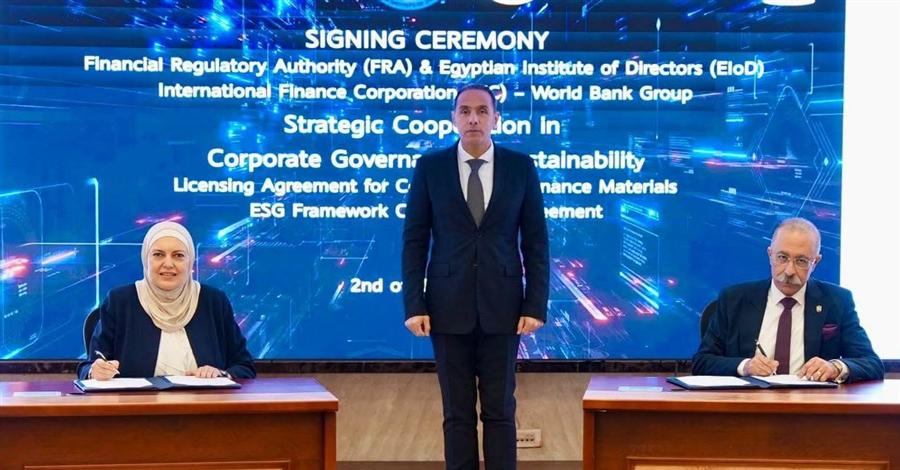
Arab Finance: The Financial Regulatory Authority (FRA) and the International Finance Corporation (IFC), a member of the World Bank Group, have signed two cooperation agreements to develop sustainability assessment tools and strengthen corporate governance practices across the non-banking financial sector, as per a statement.
The agreements cover the development of an Environmental, Social, and Governance (ESG) assessment framework and the provision of specialized educational materials to the Egyptian Institute of Directors (EIoD), which operates under the FRA.
Under the first agreement, the IFC will provide advisory and technical assistance to develop an ESG Scorecard for evaluating corporate sustainability performance, including establishing the relevant assessment indicators and technical standards.
The cooperation also includes reviewing the sustainability reporting framework currently being developed by the FRA and providing technical recommendations to improve its implementation.
Additionally, the two parties will work on defining the proposed responsibilities and terms of reference for sustainability officers within organizations, in line with international standards and best practices.
To support implementation, the IFC will organize training workshops for FRA employees on International Financial Reporting Standards (IFRS) S1, which addresses sustainability-related financial disclosures, and IFRS S2, which covers climate-related disclosures.
Chairman of the FRA Islam Azzam said the agreement forms part of the FRA's efforts to strengthen regulatory frameworks and provide institutions with practical tools to assess sustainability performance and improve the quality of ESG disclosures.
He explained that developing standardized assessment tools, updating reporting requirements, and defining sustainability officers' responsibilities would help improve the monitoring of corporate sustainability practices.
Tarek Seif, Vice Chairman of the FRA, highlighted the importance of establishing clear responsibilities for sustainability officers, particularly in overseeing sustainability-related activities, coordinating data collection and reporting, and incorporating sustainability requirements into administrative processes and decision-making.
He added that training FRA personnel on IFRS S1 and IFRS S2 would strengthen their technical capabilities in evaluating sustainability and climate-related disclosures.
Alongside the sustainability framework, the second agreement focuses on developing corporate governance training through the EIoD.
Under the agreement, the IFC will grant the Institute the right to use and develop specialized corporate governance educational materials for integration into its accredited training programs over three years.
The materials cover four areas: sustainability training for board members, board member certification, guidance for board secretaries, and internal control systems.
The programs address corporate governance improvements, board secretaries' roles and responsibilities, risk management, internal auditing, and compliance, alongside procedures for strengthening institutional governance frameworks.
Azzam said the educational materials would help expand the Institute's professional training programs and strengthen the qualifications of board members and other personnel responsible for corporate governance practices.
He added that the cooperation reflects the FRA's broader approach to developing the non-banking financial sector by combining regulatory improvements with technical training and institutional capacity-building.
Regarding the effectiveness of the training programs, Seif said their outcomes would be evaluated continuously using measurable indicators, including participant numbers, satisfaction levels, and the extent to which organizations adopt the recommendations presented during training.
He explained that these assessments would help determine the practical value of the programs and identify areas requiring further development.