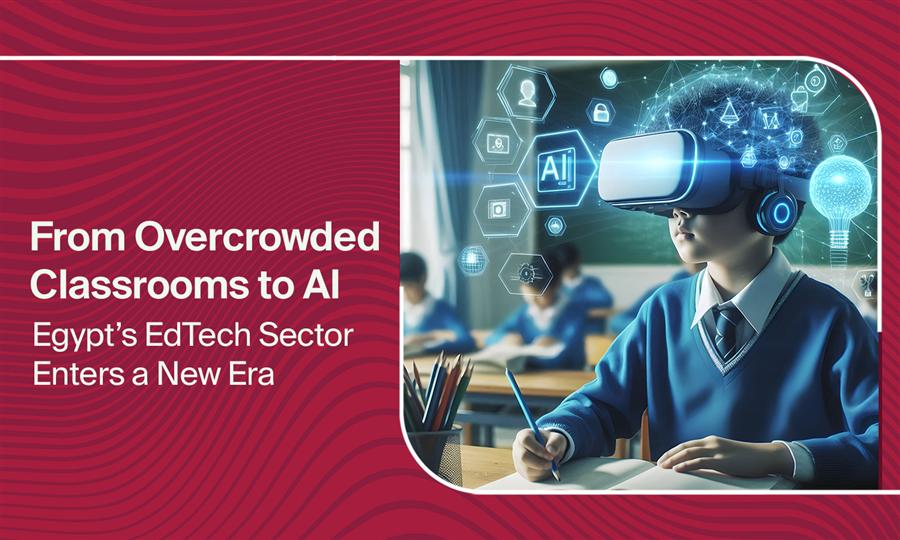
Egypt’s EdTech sector is increasingly becoming a structural pillar of national reform rather than a niche supplement. With crowded classrooms, outmoded curricula, and persistent skills mismatches, EdTech is emerging as a solution to systemic challenges and as an investment magnet.
Market expansion, government incentives, and increasing digital infrastructure are driving adoption, while resilient startups tested by price-sensitive conditions are attracting foreign capital and pioneering AI-powered learning platforms. Egypt is not only moving to modernize its education system but also aiming to become a regional hub for innovation across Africa and the Middle East, as parents, employers, and policymakers adopt digital technologies.
Market Growth and Scale
Egypt’s EdTech market has expanded significantly, rising from $441 million in 2020 to $875 million in 2025, while the number of paid learner accounts increased from 6.1 million to 9 million. According to Ken Research, this growth underscores the scalability of smart schools and digital platforms in addressing overcrowded classrooms and outdated curricula.
In the 2024/2025 academic year, the number of students enrolled in pre-university education reached 28.9 million, with average class sizes remaining high at 39 students in primary, 41 in preparatory, 38 in general secondary, and 36 in technical secondary, according to the Central Agency for Public Mobilization and Statistics (CAPMAS). These figures highlight the urgent need for scalable digital solutions
“EdTech is becoming part of the actual education system, rather than just something students use on the side,” says Andrew Edward, COO of Vertex Educational Solutions.
CAPMAS figures also show that 92.9% of schools were connected to the internet in 2024/2025, giving the government’s digital push a strong infrastructural base. This connectivity ensures that policy measures are not just aspirational but technically feasible across most of Egypt’s schools.
A Growing Ecosystem
Egypt’s startup ecosystem is home to over 1,500 active tech startups, with EdTech representing 9% of the total, according to ITIDA’s 2026 report.
Ahmed Abdelaal, Founder of Eldars and an education systems builder, highlights resilience as a defining strength of Egyptian startups. “Egyptian startups often operate under much tighter constraints than their counterparts in the Gulf. Lower purchasing power, higher price sensitivity, more limited access to continuous capital, and economic volatility force founders to learn how to operate efficiently much earlier,” he says.
“I believe the opportunity for foreign investors is not simply in finding fast-growing EdTech startups. It is in identifying companies that have already demonstrated resilience, achieved sustainable revenue, and developed strong unit economics,” Abdelaal adds.
Platforms like Sinai.ai exemplify AI-powered personalized learning. Adel Soliman, Founder of eBayan, explains to Arab Finance: “The real potential of AI is not simply generating more educational content; it is understanding where a student is struggling and adapting the learning experience accordingly.”
Soliman further emphasizes: “For platforms like Sinai.ai and the broader AI-in-education ecosystem, I believe the next major step is moving from AI as a content-generation tool to AI as an intelligent learning layer that continuously supports each student. That shift could fundamentally change how personalized learning is delivered at scale.”
Strategic Adoption
Parents are increasingly favoring schools with transparent digital tracking systems, while vocational EdTech is becoming more closely aligned with employer demand. Abdelaal believes that the most effective vocational EdTech models are likely to be at the intersection of education and employment.
“The strongest vocational EdTech models, in my view, will increasingly sit at the intersection of education and employment: understanding what employers need, translating those needs into practical learning experiences, and measuring whether learners can actually apply what they have learned,” he notes.
Abdelaal adds: “Employers are increasingly less interested in whether someone has simply completed a course and more interested in whether that person can actually perform a task or solve a real business problem. This creates an opportunity for EdTech companies to work much more closely with employers when designing learning experiences.”
Meanwhile, mobile-first learning is bridging rural-urban divides. As Soliman explains: “A smartphone is often more accessible than a computer or a traditional learning facility. But access to a device alone is not enough. The real opportunity is to make high-quality educational content, assessment, and teacher support available through experiences that work reliably on affordable devices and lower-bandwidth connections. If we design digital education around the reality of how students actually access technology, rather than assuming everyone has the same resources, mobile can become a powerful equalizer.”
However, he cautions that “the biggest barriers are not only about internet coverage. Other barriers include connection reliability, device affordability, digital literacy, access to quality digital content, and the ability of schools and teachers to integrate technology into daily workflows.”
“In many cases, the infrastructure may exist, but the digital experience is still not designed for the realities of the users,” Soliman points out.
As per CAPMAS data, student-teacher ratios stood at 22 in primary education, 21 in preparatory education, 21 in general secondary education, and 20 in technical secondary education. These figures illustrate the pressure on educators and suggest digital adoption trends are not just about convenience but about necessity, as technology helps teachers manage large classrooms more effectively.
From Local Constraints to Regional Competitiveness
Despite growth, price sensitivity remains a challenge. “Price sensitivity forces companies to prove their value much earlier,” Abdelaal argues, adding that paying customers who return are much stronger signals than a large user base.
He notes, “Companies that learn to build sustainable businesses under strong price constraints may become much more disciplined and operationally efficient when they expand into higher-purchasing-power markets.”
Connectivity gaps, device affordability, and limited digital literacy also hinder equitable adoption. Soliman warns that “equitable adoption requires us to address both the physical infrastructure and the human and operational side of digital education.”
Yet these constraints may strengthen Egypt’s competitiveness. EdTech startups that master sustainable models under tight conditions could expand more effectively into higher-purchasing-power markets.
Edward explains: “Egypt can position itself in Africa and the MENA region. We have a very young population, and we have the infrastructure and innovative minds to lead the area in EdTech.”
He adds that Egypt is “seeing more schools, universities, government, and companies using technology for learning, assessment, skills development, and employment.” From Vertex’s perspective, he says, the focus is on “whether the startup is solving a real problem, has a strong team, and has a business model that can work.”
Egypt’s EdTech sector is consolidating its role as a core driver of reform. Backed by strong market growth, rising paid learner adoption, and expanding school connectivity, the sector is building the infrastructure and policy momentum needed for widespread rollout.
At the same time, investors are increasingly drawn to resilient startups that can prove sustainable revenue and unit economics under Egypt’s price-sensitive realities, while AI platforms, including smart, adaptive learning systems, signal a shift away from content generation toward continuous, personalized learning support.
By Sarah Samir