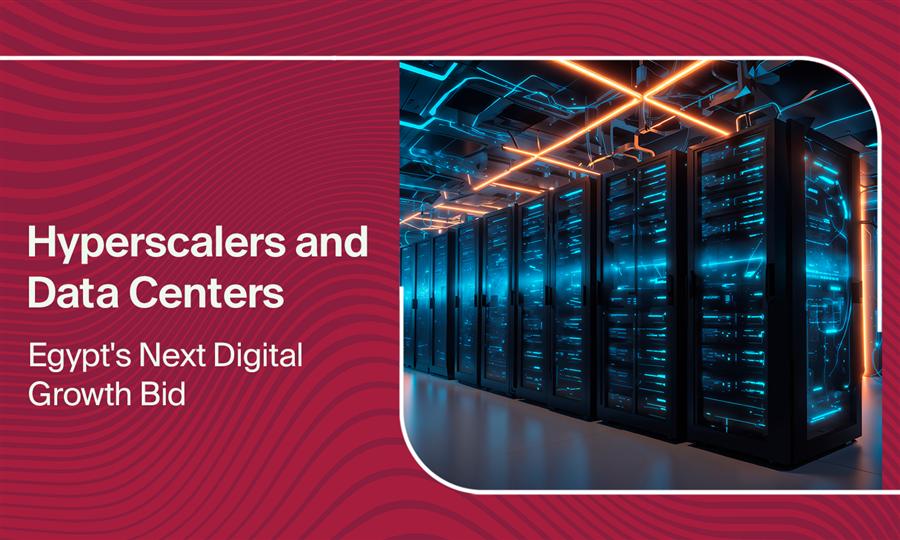
Egypt is accelerating its push to become a regional hub for data centers, channeling major investments into telecom infrastructure while leveraging its strategic geography and surplus electricity capacity. As demand for cloud computing, artificial intelligence (AI), and digital services surges, Cairo, Alexandria, and the Suez Canal Economic Zone (SCZONE) are emerging as focal points for hyperscale and colocation data center facilities. Backed by the government’s Digital Egypt strategy, regulatory reforms, and specialized free zones, the country is positioning itself as a strategic alternative to regional rivals in the Gulf.
From Transit Corridor to Data Hub
Egypt has been working on boosting its digital infrastructure while meeting growing demand for data, cloud, and technology services. The government’s Digital Egypt strategy is designed to attract hyperscalers and cloud providers through fiscal incentives, regulatory reforms, and specialized free zones.
Ahmed Yehia Hegazy, Telecom Policy Strategist and Regulatory Affairs Leader at the National Telecommunications Regulatory Authority of Egypt (NTRA), emphasizes that the sector’s requirements extend far beyond standard telecom needs.
“The data center industry is not limited to telecom; it is deeply tied to electricity,” Hegazy says. “A single data center can consume as much power as an entire industrial zone. On top of that, cooling requirements are enormous. Without proper cooling systems, facilities risk catastrophic failure or fire. Cooling is achieved primarily through water, making data centers much more than just telecom infrastructure.”
While Gulf states remain formidable competitors, Egypt benefits from a unique geographic advantage, with nearly 20% of global internet traffic transiting through it. Hegazy acknowledges that Egypt’s pricing is relatively high commercially, asserting that its strategic location leverages this advantage.
“Given Egypt’s location, where nearly 20% of global internet traffic passes through, the country leverages this advantage. Therefore, leasing infrastructure here is more expensive than in some competing markets,” he explains.
Beyond its geographic position, Egypt’s surplus electricity capacity is another key attraction for investors. Identifying this as a key economic driver, Hegazy says, “Hosting data centers generates significant revenue, while also consuming electricity, as Egypt has surplus capacity. In terms of infrastructure, Egypt serves as an international corridor, with cables crossing its territory.”
“The country capitalizes on this by leasing terrestrial conductors, creating a wholesale telecom market worth billions of pounds, although it remains largely unknown to the public,” he adds. “For example, cables transiting from Europe to India or Saudi Arabia generate substantial income. If data is hosted locally, companies also pay Egypt for the terabytes they use.”
Hegazy further highlights that these data centers impact job opportunities as they use Egypt’s human capabilities. “Hyperscalers in Egypt serve clients abroad, meaning revenues flow in dollars. Altogether, the economic impact is profound.”
Investment?Friendly Framework
Global drivers, cloud computing, AI, and big data analytics are mirrored in Egypt’s domestic market. Fintech, e?commerce, logistics, and digital government services are expanding rapidly, creating strong local demand.
In September 2025, Amr Talaat, former Minister of Communications and Information Technology, stated at the Etisal Association’s annual celebration in Cairo that Egypt’s AI sector alone could contribute 7.7% to gross domestic product (GDP) by 2030, further reinforcing the case for large?scale data center investments.
The Digital Egypt strategy places emphasis on ICT and cloud infrastructure, while public-private partnerships bridge state policy and private capital. Telecom Egypt, with its 160-year legacy and unique cable assets, plays a pivotal role in this.
Hence, Hegazy notes: “Telecom Egypt has been operating for 160 years and owns unique cable assets found nowhere else. The company is firmly established, and Egypt is steadily progressing toward becoming a regional data center hub.”
In terms of regulation, Hegazy illustrates that Egyptian law prohibits the processing of Egyptian citizens’ data outside the country. Yet, the government is working to maintain an attractive environment for investors despite the security regulations.
“Egypt’s national strategy is moving forward. Free zones and specialized data parks are being established to provide separate pathways for hyperscalers, with the first zones expected to launch next year,” he points out.
According to Hegazy, "The government is working to make the data center model more investment?friendly by balancing flexibility with national security. A framework for international hyperscalers is expected soon.”
Expanding Data Center Footprint
Hyperscale and colocation facilities are expanding across Cairo, Alexandria, and the SCZONE. According to the Data Center Map, Egypt has 13 data centers across four markets. The country’s extensive submarine cable landing stations on both the Mediterranean and Red Sea coasts strengthen its role as a digital transit corridor linking Africa, Europe, and Asia.
“Several hyperscalers are already operating in Egypt, though not widely known,” Hegazy says. “We are committed to keeping Egyptian data within Egypt and monitoring it carefully. Investors are accepting this, as the region lacks infrastructure as advanced as Egypt’s.”
Hossam Badawy, Operations Manager for Data Centers and Data Center Engineer at Telecom Egypt, highlights how vital this infrastructure is for regional connectivity, saying: “Egypt enjoys a unique geographical location connecting Europe, Asia, and Africa, making it one of the world's most strategic digital transit corridors. By leveraging its extensive network of submarine cable landing stations on both the Mediterranean and Red Sea coasts, Egypt is strengthening the role of Cairo and Alexandria as regional digital and data hubs.”
Badawy adds that "Cairo, in particular, is becoming an attractive location for cloud service providers and hyperscalers due to its connectivity advantages, while Alexandria serves as a critical gateway for international traffic entering and leaving the region.”
To sustain this expansion, Badawy emphasizes that Egypt must prioritize long-term security and governance. “To attract international investment in mission-critical infrastructure, Egypt should continue enhancing its cybersecurity ecosystem through comprehensive regulatory frameworks, stronger public-private collaboration, regular compliance assessments, and the adoption of internationally recognized standards,” he suggests.
As the market matures and the scale of these facilities grows, the focus must shift toward comprehensive institutional oversight. Badawy underscores that "as data center investments accelerate, governance and risk management become essential to ensure sustainable and secure growth. Organizations should adopt an enterprise-wide risk management approach that integrates cybersecurity, operational resilience, regulatory compliance, and business objectives”.
He further outlines that “key practices include establishing clear governance structures, defining accountability at both executive and board levels, conducting regular risk assessments, implementing change-management processes, performing third-party risk evaluations, and maintaining comprehensive business continuity and disaster recovery strategies”.
Ultimately, Badawy notes that “continuous workforce training, periodic security audits, and the use of key risk indicators (KRIs) and key performance indicators (KPIs) help organizations monitor risks while supporting rapid expansion without compromising security or service availability”.
By aligning with global frameworks like ISO/IEC 27001 and the NIST Cybersecurity Framework, while ensuring continuous workforce training, Egypt aims to support rapid, secure, and sustainable digital growth.
Egypt’s bid to become a regional hub for data centers is gaining momentum, driven by rising domestic demand, surplus electricity capacity, and its unrivaled geographic position at the crossroads of global internet traffic.
The government’s Digital Egypt strategy, coupled with fiscal incentives and specialized free zones, is laying the groundwork for hyperscalers and cloud providers to expand operations in Cairo, Alexandria, and the SCZONE. However, success will hinge on more than infrastructure.
Long?term sustainability requires robust governance, internationally recognized cybersecurity standards, and investor?friendly regulatory frameworks that balance national security with operational flexibility.
By Sarah Samir