Arab Finance: As Egypt advances its energy transition, clean-energy services companies are gaining opportunities to help businesses reduce energy costs, improve supply reliability, and lower carbon emissions. Solar power, biogas, and AI-powered energy management are expanding the range of solutions available to agriculture, industry, and oil and gas operations, including remote sites where reliable power remains a challenge.
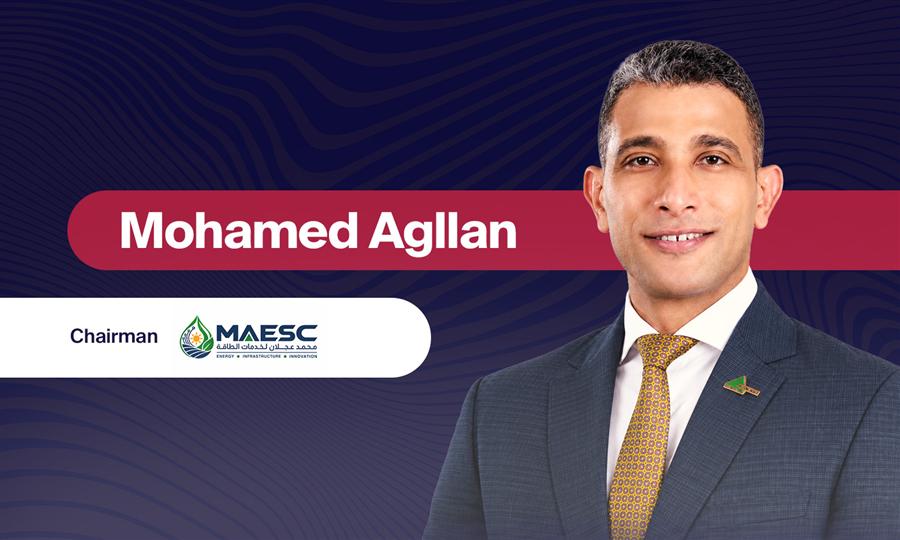
Amid this transition, Mohamed Agllan Energy Services Company (MAESC) is combining renewable-energy engineering, procurement, and construction with operations and maintenance, waste-to-energy solutions, technical training, and digital energy intelligence. In this interview with Arab Finance, Mohamed Mohey Agllan, Chairman of MAESC, discusses the company’s growth strategy, its plans to expand its clean-energy portfolio, and its ambitions to develop an integrated Egyptian platform serving markets across Africa and the Middle East.
1-Could you introduce MAESC and outline its core business activities, main service offerings, and position within Egypt’s energy services and contracting market?
MAESC was founded in 2015 as an Egyptian cleantech company with one clear conviction: energy in Egypt must become cleaner, more local, and more intelligent at the same time. Over 10 years, we have grown into an integrated energy-services ecosystem built on four pillars: renewable-energy engineering, procurement, and construction (EPC), as well as operations and maintenance (O&M) (solar plants for agriculture, industry, and remote oil and gas sites); bioenergy and circular economy (biogas units that turn farm and organic waste into clean fuel and fertilizer); technical education through the MAESC Educational Lab; and digital energy intelligence through MMT: our AI and carbon-intelligence platform.
By June 30, 2026, MAESC had delivered 671 projects and units across 24 locations in Egypt, with 25 megawatts (MW) of solar capacity under our hands: 12.66 MW installed and 12.34 MW under O&M and upgrades, alongside 131 biogas units. Our systems have helped reclaim around 168,000 acres of land, generated about 34,158 MWh of clean energy, avoided more than 16,344 tons of CO2e, and treated 5,334 tons of organic waste in our biogas units.
We are headquartered in Menoufia with branches in Minya and New Valley, hold Egypt’s Golden License for solar systems up to 3 MW, are ISO certified, including under ISO 50001 for energy management, are registered with the New and Renewable Energy Authority (NREA), are approved by the Egyptian General Petroleum Corporation (EGPC), and are registered with the Chamber of Petroleum and Mining. That combination positions MAESC as a bridge between Egypt’s traditional energy sector and its clean-energy future.
2-Which services or capabilities differentiate the company from other energy service providers and contractors?
Three things set MAESC apart. First, integration: most contractors install a system and leave. We design, build, operate, monitor, and report – and we train the people who run the assets. A client deals with one partner across the project’s life cycle.
Second, our hybrid solar–biogas model, which is MAESC’s own innovation. Solar powers the day, and biogas produced from the farm’s own waste replaces batteries at night. It lowers cost, solves the storage problem in remote areas, and turns waste from a burden into a fuel.
Third, digital intelligence. Our MMT platform, available on Google Play and the App Store, digitizes all MAESC services – maintenance, monitoring, production and emissions readings, and carbon reports – and connects certified technicians with plant owners. It is the foundation of a future carbon-credit trading platform. Few companies of our size in Egypt combine field execution, circular-economy solutions, and a working digital platform under one roof.
3-What are the main drivers of demand for energy services and contracting in Egypt today? How have the needs of oil and gas operators, industrial clients, and other energy-sector stakeholders evolved in recent years?
The first driver is the cost and security of energy supply. Fuel and electricity costs have risen, and clients – farms, factories, and remote sites – want predictable, self-generated energy. The second is the national push for land reclamation and food security, which depends on reliable off-grid pumping. The third is decarbonization pressure, especially for exporters facing carbon-border rules and international buyers who now ask for emissions data.
Client needs have clearly matured. Oil and gas operators used to buy diesel and generators; today, they ask how to power remote wells, artificial lift systems, and camps with solar energy, and how to treat camp waste through biogas. Industrial clients no longer want only a rooftop system – they want measured savings, verified carbon reports, and long-term O&M. In short, the market has moved from buying equipment to buying outcomes: reliability, savings, and proof of impact.
4-What are MAESC’s key strategic priorities for the next three to five years?
Our roadmap to 2030 has five priorities. One: scale our core solar EPC and O&M business with industrial zones, factories (rooftop and BIPV), and the petroleum sector, supported by our technical partnership with Banque Misr under the state’s solar-financing initiative. Two: expand biogas and the hybrid solar–biogas model across Egypt’s agricultural and agri-waste value chain. Three: grow MMT from a service platform into a national energy-and-carbon data marketplace with subscriptions for plant owners, technicians, and companies, and ultimately carbon-credit trading.
Four: strengthen our supply chain through a component warehouse that protects clients from price volatility and shortens delivery times, while deepening localization through partnerships with Egyptian manufacturers. Five: open a Cairo branch to serve clients faster, and build the talent base that sustainable growth requires. Revenue has grown thirteen-fold since 2020 to EGP 37.4 million in 2025, and under our growth and investment plan, we are targeting more than EGP 200 million in revenue by 2030, with gross margins rising from about 24% to 38%.
5-What major projects has MAESC undertaken recently, and what do they reveal about the company’s technical capabilities and growth direction?
Our recent work shows a company moving from individual projects to platforms and partnerships. In July 2026, we signed a cooperation protocol under which MAESC became the technical partner of Banque Misr for building solar plants – a signal of trust from Egypt’s largest bank in our engineering quality. In October 2026, at the Green Business Expo in Luxor, we signed a cooperation agreement on recycling and waste-to-clean-energy, extending our circular-economy work.
On the ground, we continue to deliver solar irrigation systems that support land reclamation in Upper Egypt and the New Valley, biogas units for farms and rural communities, and O&M and upgrades for existing plants. We have also built relationships in Africa through consulting, field studies, and training in DR Congo and Chad, and we are developing a 500 MW solar concept for Kinshasa. MAESC has been selected by five accelerator programs backed by Banque Misr, UNIDO, UNDP, GIZ, and AFD, exhibited at UNIDO’s Green Business Expo 2026, received the Egypt Sustainability Leadership Award, and is the subject of a UNDP impact case study. Together, these reveal three things: technical depth, institutional credibility, and a clear direction toward larger, integrated, and measurable clean-energy projects.
6-How do current investment trends in Egypt’s oil and gas sector affect demand for contractors and specialized service providers? Where do you see the strongest opportunities for MAESC as the country seeks to boost domestic production and develop its energy infrastructure?
As Egypt works to raise domestic production, new and revived fields – many of them remote – need power, water, and services quickly and reliably. That creates strong demand for specialized providers who can deliver in the field, not just in the office. Every liter of diesel saved at a remote site is also a liter of fuel or gas that can be redirected to the national system or exported.
The strongest opportunities for MAESC are solar power for remote sites and artificial lift, solar-diesel hybrid systems that cut fuel logistics, biogas solutions for camp waste, and digital monitoring of energy use and emissions through MMT. Our EGPC approval and registration with the Chamber of Petroleum and Mining allow us to serve operators directly. We see ourselves as the clean-energy partner that helps oil and gas companies produce more while consuming and emitting less.
7-How important are local manufacturing, engineering capabilities, and Egyptian talent to the competitiveness of energy service companies? What challenges remain in increasing local content while maintaining international standards?
They are decisive. Local content protects projects from currency swings and import delays, keeps value within the economy, and creates jobs. At MAESC, we do not manufacture products ourselves; we localize through partnerships with Egyptian manufacturers, so that structures, biogas units, and balance-of-system components are increasingly made in Egypt to our specifications.
Talent is our real competitive edge. Women make up around 60% of our team. At the MAESC Educational Lab, we have trained 605 people through hands-on training and reached around 41,000 through education and awareness programs, including dual education with German partners such as Lucas-Nülle and HLFT, alongside Egyptian universities, including Menoufia University and Delta Technological University. MMT then gives certified technicians access to paid service jobs across the country. As a certified international lecturer myself, I believe Egypt’s engineers can compete anywhere.
The challenges are real: consistent quality and certification for local components, access to testing facilities, scale for local factories to compete on price, and retaining skilled people who are in demand regionally. The answer is long-term partnerships between developers, manufacturers, universities, and banks – which is exactly the model we are building.
8-How is the shift toward lower-carbon energy affecting the traditional services and contracting business?
The transition is not replacing the traditional business; it is redefining it. Clients still need power, pumping, maintenance, and construction, but they now expect these services to be delivered with lower emissions, lower fuel costs, and measurable results. A contractor who can only install diesel-based solutions is losing relevance; one who can hybridize, electrify, and measure is gaining it.
This also changes the business model. Value is moving from one-off installation to long-term services, including operation, monitoring, performance guarantees, and carbon reporting. Data becomes part of the deliverable. That is why we built MMT: every kilowatt-hour and every ton of CO2e avoided can be tracked and reported and, in time, monetized through carbon credits. For petroleum engineers like me, the transition is an opportunity to bring the discipline of the oil and gas industry into clean energy.
9-Does MAESC see opportunities to expand beyond Egypt into other African or Middle Eastern markets?
Yes, it is a core part of our long-term vision. Africa faces the same challenges we have solved in Egypt: off-grid agriculture, remote industrial sites, and abundant organic waste, along with huge solar potential. Our hybrid solar–biogas model and our training capability are highly transferable.
We have already built relationships through consulting, field studies, and training in the DR Congo and Chad, and we are developing a 500 MW solar concept for Kinshasa, planned in stages. The Gulf is also a natural market for engineering and O&M services. We are disciplined about this: international expansion is a vision we pursue step by step, with the right partners and financing, while Egypt remains our base and our priority. We see Egypt as a launchpad for clean-energy expertise across Africa and the Middle East.
10-How do project financing requirements, payment schedules, currency fluctuations, and working-capital pressures affect contractors operating in Egypt? What changes in the business environment would help energy service companies invest and expand more confidently?
These are among the biggest challenges for any contractor in Egypt. Most solar components are priced in foreign currency, while contracts are often denominated in Egyptian pounds and paid out over months. When prices move quickly, the contractor carries the risk. Delayed payments and upfront material purchases put heavy pressure on working capital, which limits how many projects a company can take on – even when demand is strong.
We manage this through careful pricing, a planned component warehouse to hedge against price changes, partnerships with banks such as Banque Misr to finance clients’ solar plants, and disciplined financial management. That discipline is why MAESC grew every single year through two devaluations in 2022, the foreign-exchange shortage of 2023, and the float of the pound in 2024, multiplying revenue thirteenfold between 2020 and 2025 while staying profitable.
What would help most is wider green-finance products and dedicated credit lines for SMEs in clean energy; faster payment cycles for public and large-client contracts; currency-hedging tools accessible to mid-sized companies; risk-sharing and guarantee schemes for long-tenor projects; and a functioning national carbon market that turns verified emission reductions into a revenue stream.
11-Looking ahead to 2030, how do you expect Egypt’s energy services and contracting sector to evolve?
By 2030, I expect a sector that is more integrated, more digital, and more local. Renewables will no longer be a niche alongside conventional energy; they will be built into oil and gas operations, industry, agriculture, and new cities. Distributed generation – solar installations on farms, factories, and remote sites, combined with biogas and storage – will grow quickly, and contractors will increasingly be judged on their assets’ lifetime performance.
Data will become central. Artificial intelligence (AI), the Internet of Things (IoT), and digital twins will manage plants, predict maintenance needs, and verify carbon reductions. I have proposed a national Egyptian Center for Energy Intelligence and Sustainability at Egypt Forum 2026, because I believe Egypt can become a regional hub for energy intelligence serving Africa and the Middle East.
The winners will be companies that combine engineering, finance, local manufacturing partnerships, and digital platforms. That is the company MAESC is building – an Egyptian company ready to power Egypt’s growth and carry Egyptian expertise across the region.