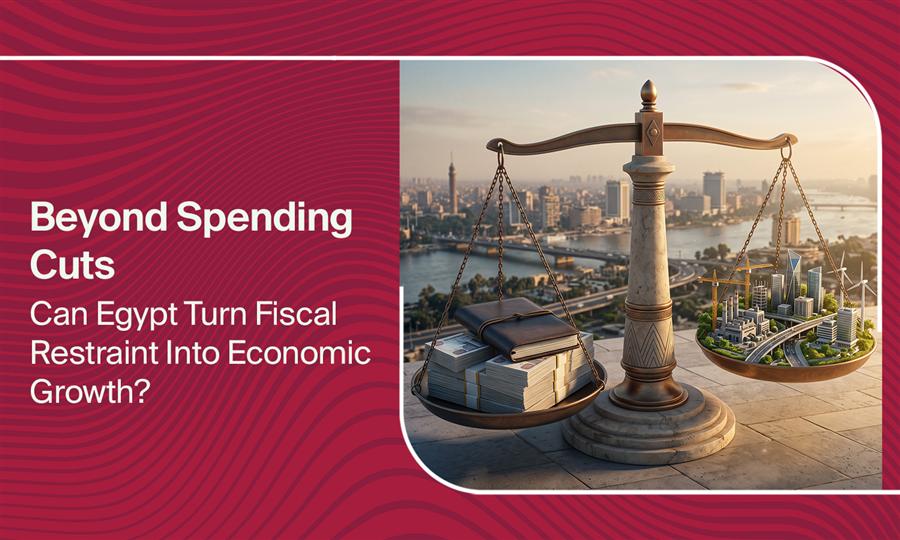
Egypt’s latest spending-rationalization measures have reignited discussions over the role of fiscal policy in addressing the country’s mounting economic challenges. As the government seeks to contain debt, ease pressure on foreign-currency resources, and improve the efficiency of public spending, policymakers are increasingly focused on how limited resources can be allocated to maximize economic returns.
While the measures are designed to strengthen fiscal discipline, reduce energy consumption, and curb non-essential expenditures, their ultimate success will depend on whether the resulting savings can be redirected toward productive investments that support growth, employment, and competitiveness. Economists argue that spending restraint alone is unlikely to deliver lasting benefits unless it is accompanied by broader reforms that encourage private-sector participation, improve the quality of public expenditure, and expand the economy’s productive capacity.
Spending Rationalization as a Tool for Fiscal Consolidation
The Cabinet recently approved a package of spending-rationalization measures covering entities included in the fiscal year (FY) 2026/2027 state budget. The decision requires government bodies to reduce electricity and lighting consumption by 20% compared with FY 2025/2026 levels and cut fuel consumption by government vehicles by at least 30%. It also postpones the implementation of fuel-intensive national projects for at least three months, suspending the launch of new government projects during FY2026/2027, and restricting contracts that would require foreign-currency procurement. Priority will instead be given to projects nearing completion.
The move comes as Egypt continues to manage fiscal and external-sector pressures. According to official data from the Ministry of Planning and Economic Development, total government debt reached EGP 17.85 trillion in the first quarter of 2026, up 8.8% from the previous quarter.
Basem Badr, a Teaching Assistant of Economics, tells Arab Finance: “I believe these measures serve several interconnected economic objectives rather than simply aiming to reduce government expenditure.”
“The primary objective is to strengthen fiscal discipline and create additional fiscal space that would enable the government to manage exceptional economic pressures, particularly those arising from higher energy and financing costs amid ongoing regional geopolitical tensions,” he adds.
Sherine Ghaly, Associate Professor of Economics at the Institute of National Planning, views the measures as part of a broader effort to improve spending efficiency and adapt to emerging global challenges. “In general, rationalizing spending is one of the main measures that should be permanent in government spending and based on the efficiency of this spending to narrow the deficit,” she says.
She adds that recent geopolitical developments and disruptions to global energy markets have heightened the need to reassess spending priorities and allocate resources more effectively.
According to Badr, energy management and external-sector considerations are also central to the government's calculations. “Reducing domestic energy consumption can help lower the import bill for petroleum products and natural gas, thereby easing pressure on the balance of payments,” Badr says. “Furthermore, restrictions on foreign currency-denominated expenditure and the postponement of certain import-intensive projects can contribute to reducing demand for foreign currency.”
As a result, he argues that “these measures should be viewed as a comprehensive approach to managing both fiscal and external pressures through more efficient resource allocation and the prioritization of essential expenditure, while preserving the resources required to maintain core public services.”
Short-Term Constraints, Long-Term Gains
The spending-rationalization measures could weigh on demand in the short term. Badr explains, “In the short term, reducing government expenditure may moderate aggregate demand, potentially creating some pressure on economic activity, particularly if spending cuts affect public investment and projects linked to production, employment, and economic activity.”
Nevertheless, he believes the medium-term benefits could outweigh the initial adjustment costs. “These measures could generate positive outcomes by reducing inefficient public expenditure, easing fiscal deficit and financing pressures, and limiting the economy's exposure to external shocks associated with energy prices and foreign currency availability,” he points out.
Ghaly, however, notes that spending restraint and sustainable growth should not be viewed as automatically interchangeable. “There are differences between short-term measures that help to decrease spending and long-term measures for sustainable growth,” she says, arguing that lasting economic gains require a long-term strategy centered on productive activity.
“In the long term, governments' successful and effective use of public resources should promote growth, which in turn contributes to sustainable growth, where rationalization makes room for increased public investment, notably in human capital, to maintain and increase the economy's capacity for production,” Ghaly adds.
Investment sentiment is likely to depend less on the spending cuts themselves and more on what policymakers do with the resulting fiscal savings. Badr argues that spending rationalization can support stronger growth if it improves spending quality rather than merely reducing expenditure levels.
“Spending rationalization becomes growth-positive when it focuses on reprioritizing public expenditure rather than implementing indiscriminate spending cuts,” he notes. “It is essential to distinguish between non-essential current expenditure and productive investment that contributes to job creation, economic output, and the expansion of productive capacity.”
Ghaly echoes this view, arguing that spending rationalization supports growth when linked to fiscal consolidation and a reallocation of resources toward productive investment. “Spending rationalization becomes growth-positive in general when fiscal consolidation lowers borrowing and shifts public funds to productive capital investments,” she says.
She stresses that accompanying structural reforms should focus on improving the efficiency of public investment and prioritizing projects that generate strong economic and social returns.
Durable gains will require broader reforms to encourage private-sector participation. Badr states that “Key priorities include strengthening private sector participation in economic activity, improving the investment climate, simplifying regulatory procedures, and directing public investment toward sectors with higher value added, particularly manufacturing, agriculture, and renewable energy.”
Badr further emphasizes that spending restraint must ultimately support productive economic activity. “More importantly, economic sustainability cannot be achieved through spending cuts alone. It requires improving the quality of public expenditure and maximizing the economic and social returns generated by every unit of public spending.”
He adds: “If the savings generated through rationalization are redirected toward productive investment, infrastructure development, and improvements in economic efficiency, these measures could evolve from a temporary crisis-response mechanism into an opportunity to support long-term economic growth.”
The Next Phase
The success of the spending-rationalization program will ultimately be judged by its measurable outcomes.
Heba Mohamed Srour, Associate Professor of Finance and Investment, believes the government’s savings could provide a meaningful near-term fiscal buffer. “The government's targeted EGP 40 billion in savings over three months represents a meaningful short-term fiscal buffer, particularly amid mounting external pressures,” she says.
However, Srour argues that the long-term value of the measures depends less on the savings target itself and more on the government's ability to translate temporary expenditure restraint into lasting improvements in spending efficiency while protecting productive investment.
Badr stresses that the broader reform agenda remains crucial: “Expanding domestic productive capacity and improving export competitiveness are essential to reducing dependency on imports and increasing foreign currency earnings.”
He also highlights the importance of “improving tax administration, strengthening fiscal governance, and conducting comprehensive assessments of the economic returns of public investment projects” to ensure the efficient allocation of available resources.
Srour also argues that financial markets will focus on implementation rather than announcements alone. “Fiscal discipline can strengthen investor confidence, but lower spending does not automatically translate into cheaper borrowing,” she notes.
According to Srour, “investors will assess whether these measures deliver credible and sustained improvements in Egypt's fiscal position. If accompanied by transparent implementation and protection of growth-enhancing investment, they could gradually reduce perceived sovereign risk and support more favorable financing conditions.”
Egypt’s latest spending-rationalization measures reflect a policy shift toward tighter fiscal management, energy conservation, and easing pressure on foreign-currency resources. Although the measures may temporarily weigh on economic activity in sectors reliant on government spending, they could strengthen investor confidence if they lead to lower fiscal pressures, improved resource allocation, and stronger private-sector participation.
The timing of the economic impact will also matter. Srour explains that “expenditure savings can begin improving fiscal cash flows within the first quarter of implementation, provided spending commitments are genuinely reduced rather than merely deferred. Their impact on the budget deficit may become visible relatively quickly, while improvements in debt-to-GDP ratios typically take longer. Sustainable debt reduction ultimately depends on the interaction between fiscal balances, economic growth, interest costs, and exchange-rate developments.”
As Badr argues, “The main challenge facing the Egyptian economy is not simply reducing public expenditure, but transforming the resources saved through rationalization into productive investments that enhance productivity, support employment, and strengthen the economy's competitiveness. This is what distinguishes a temporary expenditure-control policy from a comprehensive fiscal strategy that supports sustainable economic growth.”
By Sarah Samir