Arab Finance: In an economy where headline stabilization can obscure underlying pressures, understanding what sits behind the numbers is becoming increasingly important for businesses and investors.
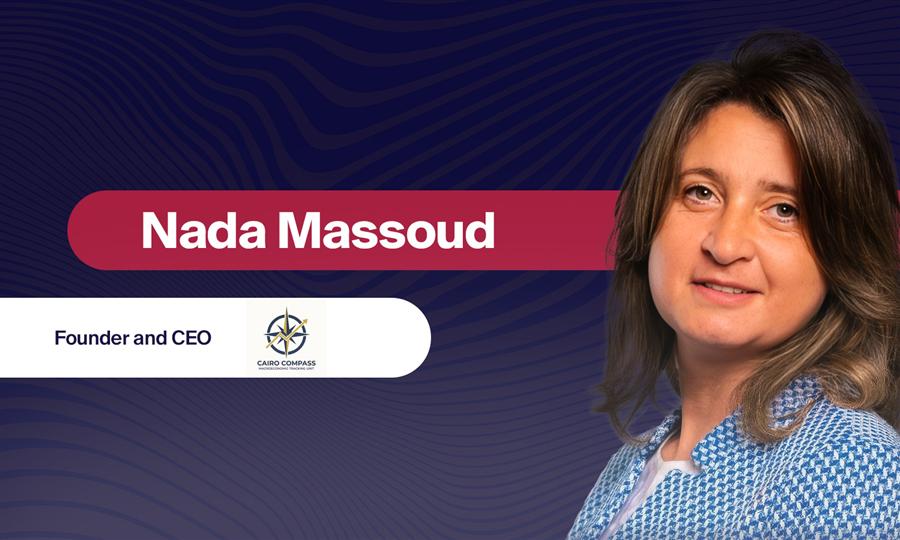
In this interview with Arab Finance, Nada Massoud, Founder and CEO of Cairo Compass, discusses the indicators she believes matter most when assessing Egypt's economy, from the composition of foreign reserves and the sources of hard currency to private-sector activity, household costs, inflation, and external financing. She also outlines Cairo Compass's approach to building transparent, auditable economic trackers, and shares her outlook on the reforms and structural shifts needed to move Egypt from stabilization toward private-sector-led growth.
1-Could you introduce Cairo Compass and explain what gap in Egypt's economic and business intelligence landscape you set out to address when you founded the platform?
Cairo Compass is an independent macroeconomic tracking unit. We publish trackers, scorecards, and indices on Egypt's economy using fixed templates, building an accountable time series rather than disposable notes.
We set out to bridge the gap between official data releases and actionable institutional decisions. Headlines report the headline level; we examine what it is made of.
August 2026 reserves offer a clear example. Net international reserves hit a record $57.2 billion, a 48th consecutive monthly rise. However, the entire monthly gain was driven by a $1.9 billion valuation surge in gold, to $19.1 billion, while foreign currency assets actually fell by $1.2 billion, to $37.6 billion. Because gold now accounts for roughly one-third of total reserves without new central bank bullion purchases, the gain reflects global gold prices rather than domestic earnings. Both numbers are accurate, but a corporate treasurer sizing a hedge needs that deeper context.
That disconnect also extends to household reality. Macro aggregates do not mirror living standards. While reserves grew for four years, the private sector minimum wage has remained unchanged at EGP 7,000 since March 2025. Egypt has also not released an official survey-based poverty rate since 2019/2020, when it stood at 29.7%, leaving a critical data gap on the impact of three devaluations and peak inflation of 38% on consumer demand.
Finally, we address transparency and rigor. We publish on a fixed calendar, explicitly flag estimated data, and openly own missed calls in subsequent editions rather than quietly revising them.
2-Could you walk us through Cairo Compass's core services and explain how they help businesses, investors, and decision-makers navigate Egypt's economic landscape?
We deliver our coverage in three formats. Reactive notes are same-day reads on scheduled releases. Trackers run the same template every month or quarter on the exchange rate, reserves, remittances, money market liquidity, SME credit, and external accounts, building a true time series. Flagship indices are the composites: the Stabilization Index, the SME Financial Health Index, and the Egypt Reform Pulse scorecard.
The format matters less than the question each reader is trying to answer.
A bank or corporate treasury needs to know whether the external buffer is durable, not simply whether it is large. That means separating the composition of reserves from their level. In the nine months to March 2026, remittances of $34.9 billion exceeded total goods exports of roughly $31.5 billion, while net FDI of $13 billion included about $3.5 billion from a single coastal land development transaction. The buffer is real, but its sources have shifted.
An investor sizing Egypt against regional peers needs the same framework applied consistently across the region, which is what our MENA work does across seven economies instead of comparing anecdotes.
A policymaker or development partner needs a scorecard that reports where a program is falling behind, not only where it is ahead. A diagnostic that only ever produces good news is of no use to the people carrying the risk.
A consumer-facing business needs the household series rather than the aggregate. In July, the largest annual increases were housing, water, electricity, gas and fuel at 31.1%, transport and communications at 21.1%, and education at 20%. With food accounting for over 44% of expenditure in the bottom quintile, a headline rate of 14.9% describes an average that very few households actually experience.
The common thread is that we hand over the evidence and the assumptions, name the source and period for every figure, and publish a forward view specific enough to be wrong.
3-What are some of the key indicators or trends that you believe businesses and investors in Egypt should be watching more closely today?
Five, and all five can be rebuilt from public data by anyone who wants to verify them.
The first is the composition of reserves, rather than their level. August is the example: a record headline carried by gold revaluation while the currency component fell. The practical test is to watch the foreign currency and gold lines separately each month. One is about flows; the other is about the gold price.
The second is how much foreign currency Egypt earns, rather than receives. Split gross hard currency receipts into four buckets: earned by selling goods and services, sent home by workers abroad, raised by selling assets, and borrowed. For the nine months to March 2026, remittances rose 32% to $34.9 billion. Non-oil imports rose 15.6% to $61.9 billion while non-oil exports reached $27.3 billion, widening the non-oil trade deficit 23.8% to $34.7 billion. That composition tells you more than the current account headline, because transfers, asset sales and borrowing are financing choices, whereas exports reflect economic capability.
The third is the gap between headline growth and what the private sector reports about itself. The central bank expects real growth of about 5% in FY2025/2026. Yet the S&P Global Egypt PMI remained below 50 for eight consecutive months through August. In August, it rose to 49.6, while job creation reached its second-fastest pace on record and business confidence hit a four-year high, even though output and new orders continued to fall. Both series are accurate. They measure different parts of the economy, and the gap tells you how much of the growth is being driven by public investment, energy, and one-off effects.
The fourth is the external financing requirement relative to the foreign currency Egypt actually holds. The central bank estimates 2026 external debt-service requirements at about $29.2 billion, including $23.8 billion in principal. Set that against the $37.6 billion of foreign currency held within reserves, rather than the $57.2 billion headline, and the position is tighter, though still manageable. The maturity profile has improved: short-term external debt fell to $30.5 billion at the end of March 2026 from $34.4 billion at the end of December 2025.
The fifth is the household cost base, which headline CPI averages away. Out-of-pocket payments account for around 62% of Egypt's health spending, while nearly 40% of household education spending goes to private tutoring. Education prices rose 20% in the year to July 2026. Health and education are the two largest channels through which a stabilizing macroeconomy can still cause a squeezed household, and neither appears in a reserves print or a growth number.
4-How do you see Cairo Compass evolving over the coming years?
Depth first, then reach. Depth, because several of our trackers are young, and a tracker earns credibility only by being marked against its own forward calls across a run of editions. We publish falsifiable ranges precisely so that this record exists and can be used against us.
Reach, because the architecture travels even though the focus is Egypt. We have published the pilot edition of MENA Compass, scoring seven regional economies on one framework. Egypt is easier to read correctly when you can see it alongside Gulf economies with more macro-financial room and peers with less room to maneuver.
Third is turning the back catalogue into a product. Once a tracker has run on a fixed template for two years, the value sits in the series rather than in the latest edition. A continuously updated view of the live composites is more useful than a shelf of dated PDFs.
Two additions matter most. One is publishing the methodology in enough detail for someone outside the firm to reproduce a composite and disagree with it on the arithmetic.
The other is building the household-level view alongside the macro one. Headline inflation eased for three consecutive months to June, while the private-sector minimum wage has been unchanged at EGP 7,000 since March 2025. Both are public facts, but they are usually reported separately.
5-How do you assess the current state of Egypt's macroeconomy, and what do you see as the key drivers and risks over the next two to three years?
Egypt is more stable than it was two years ago, but it is also more exposed on specific margins than the headline suggests. Both are true, and the second follows from the composition of the first.
The stability is documented. Net international reserves reached $57.2 billion at the end of August 2026, up from $49.3 billion a year earlier. Remittances hit a record $47.3 billion in FY2025/2026, up 29.6%. External debt fell to 40.3% of GDP by December 2025, and unemployment dropped to a record low of 5.8% in Q2 2026. Crucially, when regional conflict triggered $9.5 billion in net portfolio outflows in Q1 2026, the overall balance of payments deficit for the nine months to March still narrowed to $1.8 billion.
The exposure sits in what carried that stability. The current account deficit widened to $14.6 billion as the trade deficit rose 24.6% to $47.8 billion. The petroleum import bill doubled between January and March to $2.5 billion. Net FDI of $13 billion included roughly $3.5 billion from a single land deal — an asset sale rather than a recurring inflow. Meanwhile, the private non-oil economy contracted for eight consecutive months.
A parallel exposure sits in living standards. Household purchasing power has not recovered. The private sector minimum wage has remained frozen since March 2025 despite eighteen months of double-digit inflation. Fiscal room to cushion households is severely constrained by debt service. In the FY2026/2027 budget, interest payments of EGP 2.419 trillion absorb nearly half of planned expenditure of EGP 5.178 trillion. The debt service trajectory is therefore a primary social policy variable, not merely a fiscal metric.
Over the next two to three years, the decisive question is whether private non-oil investment moves. The government targets private investment at 59% of a total investment of EGP 3.7 trillion, aiming for a 20% investment-to-GDP ratio by FY2029/2030. Secondary drivers include whether Suez Canal revenues normalize and whether energy import costs fall back to pre-shock levels.
6-Despite stabilization, inflation and high interest rates continue to weigh on Egypt. How do you assess the trajectory, and what should we monitor for the rest of 2026?
Sequence matters more than level here, and it is frequently reported wrongly.
Urban inflation bottomed at 11.9% in January 2026 before climbing to 15.2% in March, driven by a fuel price hike of 14% to 17% and global oil price moves. It eased to 14.3% in June, then ticked back up to 14.9% in July, with core inflation at 14.7%. The disinflation of 2025 did not run smoothly into 2026; it broke in the first quarter, partially recovered, and has now stalled.
That reversal shifted the policy question from when the central bank would cut rates to whether it can hold them steady. It has held. The corridor remains at 19.00%, 20.00% and 19.50%, most recently following the August 20 meeting. Crucially, the central bank pushed its 7% inflation target horizon to the second half of 2027 rather than Q4 2026. When a central bank shifts its own horizon, that revision is the honest forecast.
Three indicators demand focus. First, the index composition: July's largest annual spikes hit housing and utilities at 31.1%, transport at 21.1%, and education at 20%. Much of today's inflation reflects administered prices and utilities rather than demand pressure.
Second, the real policy rate versus a shallow credit system. Bank credit to the private sector stood near 26% of GDP in 2025, against a global average of near 47.5%. A high real rate is being applied to a system that intermediates relatively little to private firms.
Third, household exposure. The public sector minimum wage rose to EGP 8,000 in July 2026, a 14% rise against inflation of 14.9%, while the private sector baseline remains frozen at EGP 7,000. Private tutoring absorbs nearly 40% of household education spending, and out-of-pocket payments account for over half of total health expenditure. Families cannot defer a hospital admission or a school year. That structural drag explains why consumer demand remains far weaker than the headline disinflation suggests.
7-What is your outlook for inflation over the next 12 to 18 months, and how much is temporary versus structural?
I would separate the outlook into three layers rather than give a single number, because collapsing them is what produces confident forecasts that miss.
The first is the energy and shipping shock, which is genuinely temporary. Egypt's petroleum import bill doubled between January and March 2026. As regional disruption eases, input cost inflation has hit a six-month low. If Suez Canal container traffic normalizes, significant pressure lifts on a timetable independent of domestic policy.
The second layer is administered prices. The March fuel price hike remains in the annual index for twelve months. Subsidy reform is ongoing; each decree creates a step-change in the price level and a subsequent base effect. Any projection that ignores the decree calendar is incomplete.
The third is structural pass-through. Since 2016, Egypt has repeated a cycle: nominal devaluations yield initial competitiveness gains, which domestic inflation then erodes. Until the inflation differential against trading partners narrows, imported cost pressure recurs cyclically. Housing, utilities and essential services reflect structural gaps, and high interest rates cannot reach that floor.
Putting these factors together, disinflation should resume over the next 12 to 18 months, but on a shallower, less linear path than in 2025. The central bank's revised target horizon, which has been pushed to H2 2027, is the most credible marker available.
8-As Egypt approaches the end of its current IMF program, what should become the main anchor for investor confidence?
The IMF's own assessment is a fair starting point: stabilization policies took hold, but progress on deeper structural reform remains uneven, with reducing the state's economic footprint and leveling the playing field as critical outstanding items.
As the program ends, five things could replace the external anchor: a public, falsifiable target tracker for private investment and non-oil exports; measuring competitive neutrality rather than simply tracking divestment proceeds; a multi-year human capital path toward the constitutional spending floors for health and education; reform of the fiscal architecture; and greater data transparency.
The last of these matters more than it sounds. Publishing reserve compositions, short-term external debt maturities, arrears, and an updated household income and consumption survey on a fixed calendar costs little and directly replaces part of the verification function the IMF provided. The missing poverty survey is currently interpreted as a sign of exposure rather than a matter of discretion.
There is real progress elsewhere. The central bank reported in August 2026 that 79% of citizens hold active transaction accounts, up from a third of adults a decade ago. That fundamentally changes the plumbing for cash transfers and small-business lending.
9-Looking ahead three to five years, what would constitute a genuinely successful economic transformation for Egypt?
Transformation must not be confused with stabilization. Egypt has proved it can stabilize — reserves have risen for 48 consecutive months, the parallel market premium has dissolved, and the external debt ratio is falling. Success means the private, non-oil economy becoming the engine of growth rather than its passenger.
I would measure genuine transformation against five tests.
Private investment realization: the private share of total investment holding at or above the targeted 59% in FY2026/2027, driving overall investment toward 20% of GDP by FY2029/2030.
Sustained non-oil expansion: the PMI is maintaining readings above 50 rather than allowing headline GDP to outrun business sentiment. August's 49.6, featuring record hiring and a four-year-high in confidence, hints at a turn; four consecutive prints above 50 would confirm it.
Export-led external accounts: goods exports regaining ground after falling below remittances, which reached $34.9 billion against roughly $31.5 billion in goods exports in the nine months to March 2026.
Credit intermediation: private-sector credit depth expanding well beyond the current, shallow level of 26% of GDP.
Measurable living standards: a published poverty survey updating the 2019/20 benchmark of 29.7%; out-of-pocket health costs dropping from over 50% toward the WHO's 15–20% safety threshold; and public health and education outlays moving toward their constitutional floors.
The final test is the implementation of the green transition. Egypt has built the institutional architecture, including sustainability bonds, carbon trading platforms, and hydrogen frameworks, yet the energy import bill doubled in Q1 2026. With the EU's Carbon Border Adjustment Mechanism now pricing the emissions intensity of Egyptian steel, cement, and fertilizer exports, industrial decarbonization is no longer a reputational ambition; it is an export-competitiveness deadline.