Arab Finance: The eighth edition of the Decision Makers conference, held at the Grand Egyptian Museum under the theme “Investment, Real Estate, and Tourism: Egypt’s Economic Growth Triangle 2026,” examined the impact of global economic and geopolitical developments on the investment landscape, with speakers outlining opportunities and challenges across key sectors expected to support growth in the coming years.
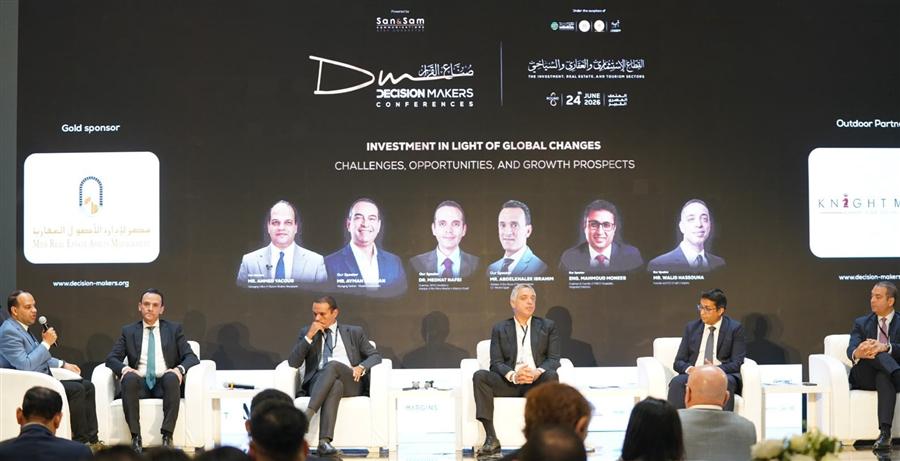
During a panel discussion titled “Investment Amidst Global Changes: Challenges, Opportunities, and Growth Prospects,” participants discussed how ongoing international uncertainties are reshaping investment decisions and influencing economic priorities.
Opening the session, Ahmed Yacoub, Managing Editor of Youm7 newspaper and moderator of the discussion, said recent years have created a different economic reality driven by successive geopolitical tensions, requiring a reassessment of investment strategies and risk management approaches. He also highlighted the importance of drawing on the expertise of economic leaders to help define priorities for the next phase of development.
Medhat Nafei, Chairman of NYM Consultancy and a member of the Prime Minister’s Advisory Council, said uncertainty has become a structural feature of the global economy rather than a temporary cycle, underscoring the need for more resilient and adaptable economic policies.
Nafei noted that Egypt has increasingly focused on tourism, non-petroleum manufacturing, and information and communications technology as sectors capable of generating added value, creating jobs, and boosting foreign currency revenues. He added that elevated interest rates remain a challenge for investment activity, stressing the importance of expanding the industrial base, particularly in engineering and food industries, to meet domestic demand and support export growth.
Meanwhile, Walid Hassouna, founder and CEO of Valu, said financial technology has become an important factor influencing investment decisions. He praised the role of the Central Bank of Egypt (CBE) and the Financial Regulatory Authority (FRA) in developing the sector’s legislative and regulatory framework.
Hassouna added that the Egyptian market has demonstrated resilience in absorbing fluctuations in exchange rates and interest rates, helping maintain investor confidence. He also pointed to the rapid growth of non-banking financial services, noting that consumer finance activity has recorded significant financing volumes in recent years, while emphasizing the need for continued oversight to support sustainable growth and effective risk management.
Focusing on tourism, Mahmoud Mounib, Chairman and Founder of Finest Integrated Solutions, said Egypt’s tourism assets position it to attract additional investments. He noted that the country will need approximately 250,000 additional hotel rooms by 2030 to accommodate projected growth in visitor numbers.
Mounib mentioned that hotel investments require broader participation from financial institutions and investment funds, alongside expanded public-private partnerships, particularly in infrastructure projects. He also called for greater localization of industries related to hotel furnishing and operations to reduce import dependence and ease pressure on the trade balance.
Ayman Soliman, Managing Partner of Morpho Investments, highlighted Egypt’s geographic location, economic diversification, and growing industrial base as key competitive advantages. He said exchange-rate flexibility has contributed to improving investor perceptions of the Egyptian market and stressed the importance of leveraging the country’s resources and human capital while strengthening industries connected to African markets to increase exports and create additional economic value.
Addressing the real estate sector, Abdelkhalek Ibrahim, member of the House of Representatives and CEO of Nevera Egypt, noted that future growth will depend on maintaining sustainable real demand and continuing efforts to regulate the market. He noted that the focus is no longer limited to developing projects but also extends to ensuring their efficient operation throughout the year.
Ibrahim also called for further development of legislation governing relationships among stakeholders in the real estate sector and for incentives that enhance the competitiveness of the Egyptian market regionally. He emphasized that governance remains a key factor in ensuring project success and maximizing economic returns.