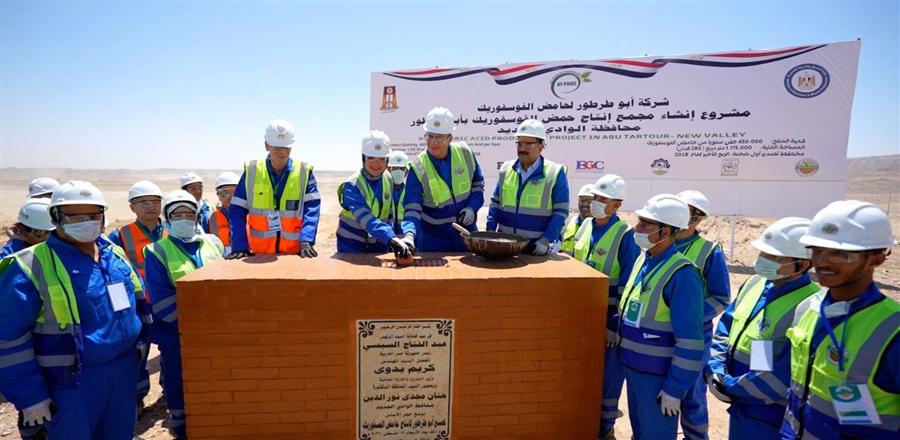
Arab Finance: Egypt has broken ground on a $658 million industrial complex for the production of phosphoric acid from locally sourced phosphate ore in the Abu Tartour Plateau, New Valley Governorate, as per a statement.
Minister of Petroleum and Mineral Resources Karim Badawi and New Valley Governor Hanan Magdy laid the foundation stone for the project, which is designed to produce 250,000 tons of high-concentration commercial phosphoric acid annually during its first phase.
The project is scheduled for completion within 30 months and is expected to create more than 3,000 direct and indirect jobs. Its output, a key ingredient in fertilizer production, will be exported through Safaga Port to generate foreign currency.
Chinese contractors China State Construction Engineering Corporation (CSCEC) and East China Engineering Science and Technology Co. (ECEC) are implementing the complex using advanced production technologies.
Badawi said the complex supports Egypt’s efforts to increase the economic value generated from its mineral resources by processing raw materials into higher-value industrial products.
He added that the ministry had worked over the past year to resolve obstacles that had delayed the project for several years, allowing it to move into the implementation phase through coordination with MRMIA and the project’s shareholders.
The minister also highlighted the transformation of the Mineral Resources and Mining Industries Authority (MRMIA) into an economic public authority, under directives from President Abdel Fattah El-Sisi, describing the move as a significant step in developing Egypt’s mining sector.
According to Badawi, the transformation is intended to increase mining’s contribution to the national economy, attract further investment, and encourage the development of downstream industries based on mineral resources.
He said the change extends beyond the authority’s name and introduces a more flexible and efficient operating framework. Its board will include representatives from relevant government bodies to help streamline procedures, support investors, reduce investment risks, and strengthen the business environment for mining industries.
For her part, Magdy said the phosphoric acid complex would support mining and industrial development in the governorate and strengthen Abu Tartour’s role as a base for mineral-based industries.
She said New Valley Governorate would provide the support and coordination required to advance mining and industrial projects and increase their development impact on local communities. She also credited the petroleum ministry with helping overcome the challenges that had delayed the complex.
Furthermore, during the visit, Badawi and Magdy reviewed private-sector plans for two integrated industrial complexes that would combine phosphate extraction with downstream manufacturing.
Movingfert Chairman Sherif Zeid presented the company’s plan to build an industrial complex in Abu Tartour covering phosphate extraction, ore upgrading and concentration, fertilizer production, and the utilization of rare earth elements.
Genesus Mining also outlined plans for an integrated industrial complex in the Dakhla Oasis. The project would include phosphate exploration, fertilizer and phosphoric acid production, and other higher-value products.
The two projects are intended to expand private-sector participation in mining industries and develop integrated production chains extending beyond raw-material extraction.
Badawi and Magdy also inspected phosphate production at Misr Phosphate Company’s mines on the Abu Tartour Plateau, including crusher No. 8, where they met workers at the production sites.
Badawi said workforce development and improved operational capabilities were central to achieving the mining sector’s objectives and increasing the utilization of Egypt’s mineral resources.
Misr Phosphate Chairman Nasser Shaheen said the company is Egypt’s largest phosphate ore producer, with annual production capacity of 7 million tons across its operations in Abu Tartour, El-Sebaiya, and the Red Sea.
The company is working on two downstream projects, including the Abu Tartour phosphoric acid complex, in which it holds a 25% stake. It is also developing a phosphate fertilizer complex in Ain Sokhna with Indorama, with an annual production capacity of 600,000 tons.