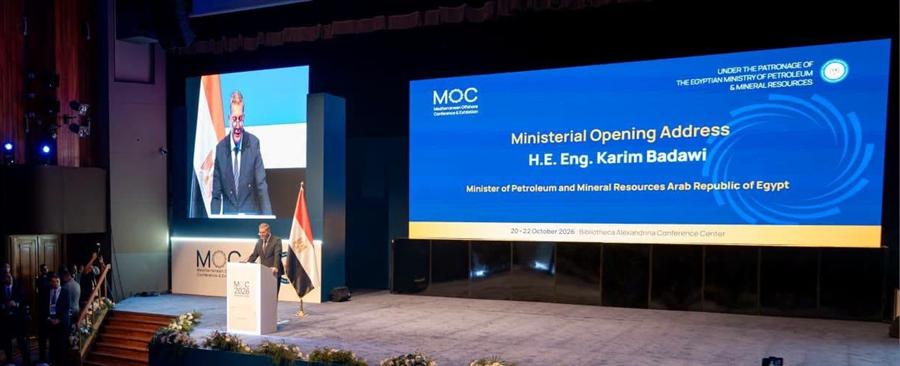
Arab Finance: Egypt brought 591 new wells into production and recorded 113 discoveries between July 2024 and June 2026, Minister of Petroleum and Mineral Resources Karim Badawi said, outlining efforts to increase domestic oil and gas output and offset natural declines at existing fields.
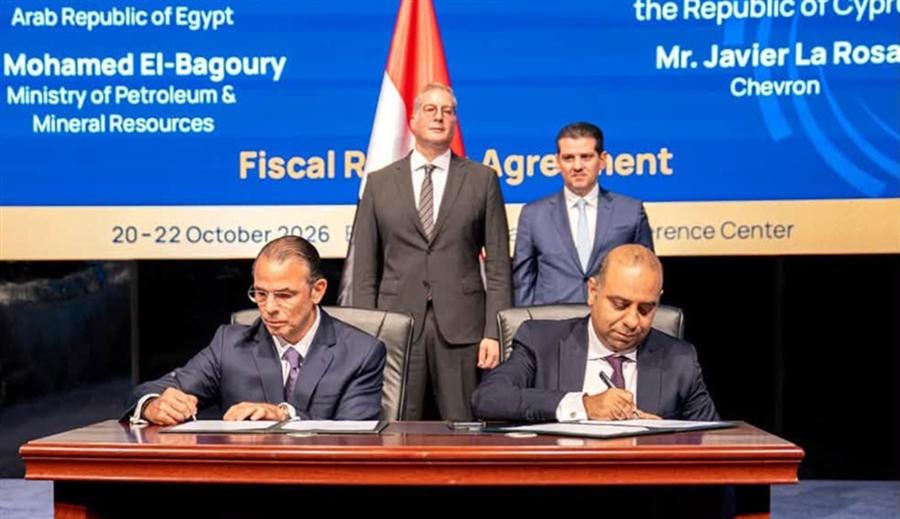
Speaking at the opening of the Mediterranean Offshore Conference and Exhibition (MOC 2026) at the Bibliotheca Alexandrina, Badawi set out priorities for investment, field development, and regional cooperation. The event is being held under the theme Egypt as an Anchoring Force for Energy Security in the Mediterranean.
Badawi said Egypt had settled all outstanding dues to investment partners involved in exploration and production, clearing arrears that had reached approximately $6.1 billion more than two years earlier. The settlement marks a foundation for renewed confidence and mutual commitment, helping the sector attract investment and accelerate resource development.
Building on that progress, the ministry is expanding exploration, developing existing fields, and improving investment models to encourage additional capital. Its priorities include accelerating production from new discoveries, making fuller use of operating fields, and adopting the latest technologies.
Contractual and economic arrangements are also being refined to provide fair returns for investors and the state while sustaining investment over the long term. Badawi said Egypt was committed to a more stable and transparent investment environment, with competitive opportunities based on shared interests that could translate into projects and additional production.
He acknowledged that geopolitical tensions, market volatility, and pressure to secure energy supplies were creating challenges across the global industry. Egypt had addressed its own sector’s difficulties through coordinated government action, political support, and cooperation with investment partners.
Turning to regional cooperation, he highlighted Egypt’s geographical location, extensive gas transmission networks, processing facilities, natural gas liquefaction and export plants in Idku and Damietta, and refining and petrochemical capabilities as assets supporting its role as a Mediterranean energy hub.
Maintaining that role, however, requires continued investment, efficient operations, competitive commercial agreements, and cooperation that makes the best use of regional resources, he said.
The minister also identified opportunities with Cyprus, Greece, Italy, and Libya to connect their resources with Egyptian infrastructure and consumer markets, improving project economics and strengthening energy security.
Badawi stressed that the next phase should focus on implementation, bringing discoveries into production and turning investment prospects into partnerships with measurable economic returns. Projects ready for execution and commercially sound opportunities serving all parties would take priority.
Meanwhile, Cyprus’s Minister of Energy, Commerce, and Industry Michael Damianos noted that the connection between Cypriot gas resources and Egyptian infrastructure is a practical example of regional integration. The partnership was entering a new phase as Cyprus moved from exploration toward development and production, with the Cronos and Aphrodite fields central to that transition.
The Cronos project is planned to use facilities associated with Egypt’s Zohr field and the Damietta gas liquefaction and export plant. Aphrodite, meanwhile, is expected to supply gas to Egypt’s domestic market. Damianos added that these arrangements would increase the economic benefits of Cypriot resources and deepen integration between the two countries.
Using existing Egyptian infrastructure and energy expertise offers a route to markets and can accelerate the conversion of discoveries into economic value, he pointed out. It would also allow Cypriot gas to contribute to regional supplies and European energy security.
Damianos emphasized that cooperation is essential to developing Eastern Mediterranean resources because offshore projects are complex, require substantial investment, and depend on infrastructure connecting production sites with markets.
He said Egypt and Cyprus had built their energy partnership around geographical proximity and a shared commitment to stability and prosperity through economic integration. Regular dialogue, technical exchanges, and commercial partnerships over recent years have produced practical solutions that reduce costs, shorten the time needed to bring offshore fields into production, and improve their commercial viability.
Alongside production and regional trade, Badawi highlighted the potential to generate greater value from Egypt’s natural resources through industry. Natural gas is both an energy source and a key feedstock for petrochemicals and fertilizers.
Closer integration between energy production and manufacturing could support domestic industrial development, employment, exports, and higher economic returns. Modern technology and artificial intelligence also offer opportunities to improve exploration results, lower costs, raise operating efficiency, and strengthen project economics, he said.
Badawi pointed to Alexandria as an example of the sector’s interconnected activities, welcoming participants to a governorate whose operations span oil and gas production, processing, refining, petrochemicals, and petroleum product transportation and distribution. Its assets include gas production projects in North Alexandria and the West Nile Delta, the Western Desert Gas Complex, and several petrochemical facilities. The governorate also hosts refineries operated by Middle East Oil Refinery (MIDOR), Alexandria Petroleum Company, and Amreya Petroleum Refining Company.
In total, Alexandria has four oil refineries accounting for approximately 45% of Egypt’s refining capacity, alongside five petrochemical complexes. Badawi said the integration of these activities helps turn energy resources into products with greater added value and supports further growth.
He called for the international expertise represented at MOC to support knowledge exchange, technology transfer, technical and economic solutions, and partnerships capable of delivering projects with tangible results.
Developing the workforce would remain central to those ambitions, he added, emphasizing that successful projects depend on qualified personnel, accumulated experience, and continually improving national capabilities. Education and training should align with industry needs, with stronger technical instruction and more opportunities for young people to contribute to the sector’s future.
Addressing younger participants, Badawi emphasized the importance of knowledge, sustained effort, and innovation. He also thanked petroleum and mineral resources workers across production sites, industrial facilities, research centers, and other operations for their contribution to progress and higher output.