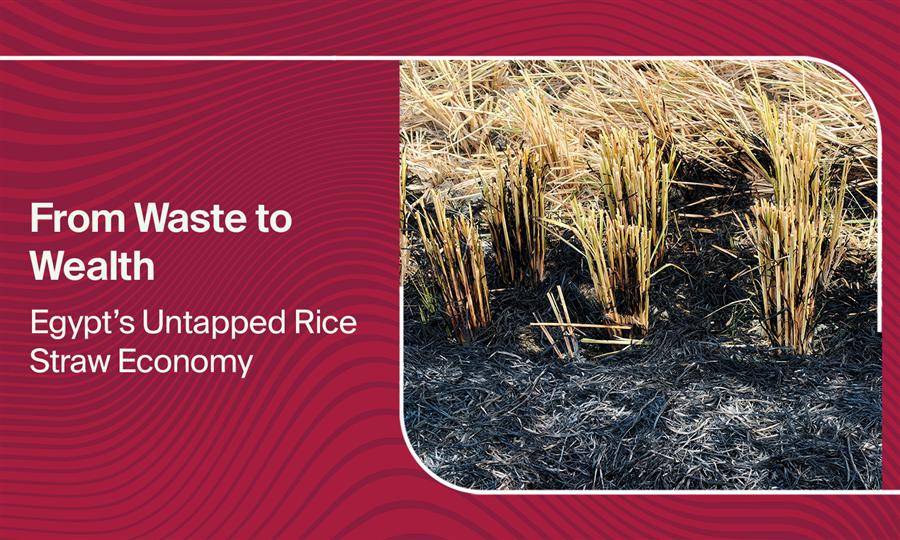
Unlocking this value could help reduce pollution, create rural income, attract private investment, and develop local alternatives to imported industrial inputs. The challenge is no longer whether rice straw can be put to productive use, but whether Egypt can develop the collection systems, storage infrastructure, market demand, and investment framework needed to turn agricultural residue into a viable industry.
The Scale of Egypt’s Rice Straw Opportunity
Egypt produces over 4.45 million tons of rice straw annually across 13 governorates, according to the study titled Environmental and Energy Performance of Rice Straw-Based Energy Pathways in Egypt: Life Cycle Assessment and Supply Chain Optimization, published in April 2026.
Despite being one of the country's largest agricultural residue streams, much of rice straw’s economic potential remains untapped. A 2024 study titled Comparative Study of Rice Straw Recycling Systems estimated that only around 20% of rice straw was being used for productive purposes, such as ethanol production, paper manufacturing, fertilizers, and animal fodder. The study serves as an indicator of the scale of unrealized value, even if it does not represent an official current national recycling rate.
Earlier this month, the Ministry of Agriculture announced that 60% of the rice harvest had been completed, with approximately 610,000 tons of rice straw recycled as part of anti-pollution measures.
Quantifying the Missed Opportunity
Rice straw's economic potential extends far beyond traditional recycling. The material can serve as feedstock for biomass energy and biofuel generation, organic fertilizers, compost, engineered wood products, insulation materials, and potentially carbon-reduction markets. Each pathway captures value from what was once considered agricultural waste.
The most significant opportunities include biomass and renewable energy. Rice straw can be converted into energy products ranging from solid fuel pellets to advanced bioenergy applications. As Egypt seeks to diversify its energy mix and reduce its dependence on imported fuels, agricultural residues present an increasingly attractive domestic resource.
Additionally, one of the most commercially promising applications is the production of medium-density fiberboard (MDF) and engineered panels used in furniture and construction. Egypt's planned rice-straw-based MDF project in Beheira Governorate illustrates the scale of industrial interest. Announced in 2020 by the Ministry of Petroleum, the project was valued at approximately €210 million and was designed to produce industrial materials locally using rice straw while reducing pollution associated with open burning. Its intended end markets include furniture, construction, and decoration industries.
Rice straw can also support the development of sustainable building materials, an area increasingly aligned with Egypt's climate and energy-efficiency objectives.
Converting rice straw into compost and organic fertilizers creates an additional revenue stream while improving soil quality and reducing reliance on chemical inputs.
According to Mohamed Abdelhameed Ahmed, Associate Professor of Agricultural Economics, the economic returns from rice-straw recycling vary significantly depending on the end use. “Think of rice straw as a hidden asset. The most profitable use right now in Egypt is turning it into compost fertilizer. It is cheap to set up, farmers save money on chemical fertilizers, and the soil gets healthier,” he tells Arab Finance.
He notes that more advanced applications can generate higher returns but require substantial capital investment. “On the higher-tech side, bioenergy projects — like ethanol or biogas plants — can deliver strong returns (20–27% IRR in feasibility studies), but they need serious investment and infrastructure. Other uses, like animal feed or construction materials, are viable but not as lucrative because of treatment costs or limited demand,” Ahmed explains.
From Waste to Industry
The profitability of rice straw recycling relies less on processing technology than on supply chain logistics, including collection, transport, storage, and seasonal supply. Ahmed agrees that logistics remain the sector's primary economic challenge. “Here’s the catch: rice straw is bulky and scattered across thousands of small farms. The collection and transport costs eat up profits. Farmers often burn it because that’s free and quick,” he says.
He adds that storage and enforcement challenges further undermine investment incentives. “Add to that poor storage conditions — straw rots fast in open air — and weak policy enforcement against burning, and you see why higher-value uses haven’t taken off. The economics are solid, but the logistics are the choke point,” Ahmed notes.
Meanwhile, Saber El Saadany, Leading Sustainability Expert, notes that high-value industrial applications offer the best investment potential.
“MDF and engineered building materials offer the strongest potential due to their higher added value, industrial demand, and scalability,” El Saadany tells Arab Finance.
He also stresses that the industry's future depends on private-sector leadership backed by supportive public policy. “Private investors should lead financing, technology, and operations, while the government ensures regulatory stability, infrastructure, and investment incentives," he says.
For investors evaluating potential projects, El Saadany highlighted several key metrics for assessing investment viability: “Feedstock costs, conversion efficiency, EBITDA margins, CAPEX, ROI, and long-term market demand.”
Summing up the challenge, he argues that “Egypt must move beyond waste management toward industrial value creation, transforming agricultural residues into profitable, sustainable resources.”
Rice Straw-Based Building Materials
Among the most compelling opportunities is the use of rice straw as a construction and insulation material. Research published in 2024 under the title Recycling Egyptian Rice Straw to Produce Low-Cost Building Materials for Energy Saving found that incorporating rice straw into mortar significantly improved thermal insulation performance. The researchers reported that adding rice straw equivalent to 20% of cement’s weight reduced the mortar’s thermal conductivity by approximately 70% under the tested conditions.
The economic implications are potentially far-reaching. Improved insulation can lower energy consumption in buildings, reduce cooling costs, support affordable housing initiatives, and substitute for some imported insulation products.
According to Walid Saleh, PhD, P.Eng., Water and Environment Expert, the greatest advantage may emerge over a building's entire lifecycle rather than in initial construction costs. “The material price is the smaller part of the story. The larger part is the electricity bill over the life of the building,” he tells Arab Finance.
“Insulating the building envelope can cut cooling demand substantially in Egyptian homes, and cooling is where household and grid costs are rising fastest,” he says.
Saleh believes locally manufactured insulation products could help address one of the main challenges facing energy-efficiency standards. “A locally made, pound-priced insulation product could make compliance affordable at the scale of state housing programs.”
At the same time, public procurement will remain crucial for creating early demand. “If public housing specifications require a performance standard that local straw-based products can meet, that creates the anchor demand the industry needs, and it creates rural income in the Delta at the same time,” Saleh adds.
Strategic Market Positioning and Regional Export Potential
Industrial confidence in rice-straw-derived products is becoming increasingly visible. Accordingly, successful commercialization could position Egypt as a regional supplier of sustainable construction materials. Saleh explains that Egypt can become a regional supplier of green building materials, “but only if rice straw is treated as an industrial input rather than a waste problem.”
“Feedstock is not the constraint. Egypt produces several million tons of straw a year, and the state has expanded its collection network quickly. The constraint is demand,” he notes.
“The Gulf is the natural first market, since cooling loads are high and energy codes are tightening. Egypt already exports building materials into the region, so the trade routes and buyer relationships exist,” he adds.
Rice-straw-derived insulation products could also help reduce dependence on imported materials. “Conventional insulation is priced off global petrochemical and trade markets, while straw is a domestically sourced resource priced in Egyptian pounds, so local production is partly a hedge against exchange-rate pressure,” Saleh highlights.
Egypt’s rice straw economy will be built or missed in the details of implementation. The technologies and end markets are increasingly clear: compost and organic fertilizers offer near-term, low-capital entry points, while MDF, engineered panels, and straw-based insulation can create higher-value industrial demand and reduce reliance on imported materials. What will determine whether these opportunities materialize is the ability to organize a reliable, year-round supply chain, lower collection and transport costs, secure storage, and establish stable procurement channels that give investors confidence to commit capital.
By Sarah Samir