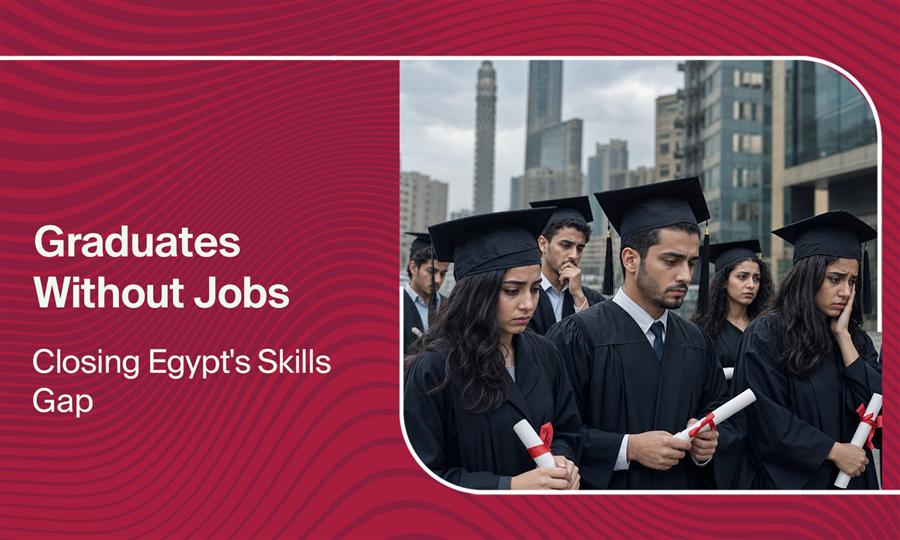
Egypt’s labor market is improving on paper, but its underlying challenges remain structural. Universities continue to graduate students faster than curricula evolve to meet employer needs, creating a persistent mismatch between education and the technical, digital, language, and soft skills demanded by the private economy. Consequently, there is a persistent skills gap; technical, digital, language, and soft skills are in short supply, leaving many degree holders underemployed while private-sector demand goes unmet.
The Skill Gap
Egypt’s unemployment rate fell to around 6% in the first quarter (Q1) of 2026, according to the Central Agency for Public Mobilization and Statistics' (CAPMAS) Q1 2026 labor force survey. However, “this aggregate figure does not mean that the mismatch between education and employment has disappeared,” Ahmed Fawzy Hussein, PhD Holder and Assistant Professor of Economics, says.
Hussein notes that “CAPMAS data for Q3 2025 showed that 43.4% of unemployed Egyptians held a university or postgraduate qualification, while 83.1% had at least an intermediate, above-intermediate, university or postgraduate qualification.”
In 2024, 97.3% of job vacancies were in the private sector, underscoring the sector’s dominance in job creation. Yet, employers continue to report shortages in technical, problem-solving, and customer-handling skills. Meanwhile, the public sector remains focused on basic literacy, numeracy, and language proficiency.
Moreover, CAPMAS reported in February 2026 that service and sales workers accounted for the largest share of employment (28%) and job vacancies (19.2%), while craft and elementary occupations showed significant gaps between current employment and demand.
Similarly, employment outcomes vary sharply by field. According to the OECD-cited 2021 Employment of Tertiary Education Graduates Survey, employment rates reached 78.3% for engineering graduates and 76.9% for health graduates, compared with just 25% for social sciences graduates and 35.5% for those in arts and humanities.
“Even a moderate mismatch becomes a major economic and social issue when multiplied across such a large number of graduates,” Hussein points out.
From Occasional Consultation to Continuous Co-Creation
Hussein calls for a permanent system of labor-market intelligence and curriculum governance to better align education with the economy's evolving needs. He proposes a national skills and graduate outcomes observatory, supported by sectoral skills councils across manufacturing, ICT, healthcare, agriculture, and energy. These bodies would publish annual occupational demand forecasts and embed employer participation into accreditation processes.
“Egypt does not merely face a shortage of education; it faces a shortage of continuously updated, economically relevant, and verifiable skills,” Hussein says.
To address this, he argues that curricula should undergo a comprehensive external review at least once every three years, while a flexible portion—perhaps around one-quarter of the program—should be updated annually through electives, short modules, and industry-certified courses.
“This is particularly important in fields such as artificial intelligence (AI), cybersecurity, renewable energy, logistics, advanced manufacturing and financial technology, where a traditional five- or ten-year curriculum revision cycle is economically unacceptable,” Hussein explains.
He also urges performance-based funding for universities and stronger industry exposure for faculty and students.
Building on this, Maryam ElGaby, a workforce development and strategic partnership expert, highlights, “The first step is to move from occasional consultation with employers to continuous co-creation. Industry should be involved not only in reviewing curricula but also in defining learning outcomes, identifying emerging skills, participating in curriculum design, and providing real-world projects, internships, and guest lectures.”
“Universities also need structured mechanisms to regularly collect employer feedback and use labor market data to update programs. The pace of change in today's job market requires curricula to be agile and responsive rather than remaining unchanged for several years,” ElGaby points out.
Skills in Demand
While institutional reform is essential, Israa Nouh, Global Talent Partner, highlights the practical hurdles faced by fresh graduates entering a market deficient in foundational modern tools.
“Language skills and AI literacy. Those are the two major factors the market is currently missing, and being fluent in both will definitely put applicants in a very competitive position compared to others. Most universities here rely on books rather than real case studies,” Nouh says.
“Graduates will not be asked about Shakespeare’s sonnets, but they will definitely be asked how to apply the skills they gained to real-world, day-to-day situations,” she further explains.
In addition, she notes that early graduates often struggle to decide which role or industry to pursue. “They may spend some time trying different opportunities before they are ready to choose. To do this, they can ask companies for internships, and they do not necessarily have to be paid. They need experience, which is priceless,” she says.
Nouh also highlights freelancing and online self-study as viable paths to build practical experience.
“Startups are not always looking for certifications; they just want someone who can get the job done at a low cost. I would also recommend online self-study. They can find courses on YouTube that teach everything step by step for free, which is the best part,” she adds.
A Shared Responsibility
ElGaby stressed that employability is often viewed as the sole responsibility of graduates but as a shared responsibility across the entire ecosystem. “Educational institutions, employers, policymakers, and organizations supporting workforce development all play critical roles in preparing young people for successful careers.”
“Students cannot develop market-relevant skills if educational programs are disconnected from employer needs, and employers cannot expect job-ready graduates without engaging in shaping the talent pipeline,” she adds.
Reiterating her earlier point, "The first step is to move from occasional consultation with employers to continuous co-creation. Industry should be involved not only in reviewing curricula but also in defining learning outcomes, identifying emerging skills, participating in curriculum design, and providing real-world projects, internships, and guest lectures."
ElGaby adds that sustainable employment outcomes are achieved when all stakeholders work together to build clear pathways from education to employment.
She emphasizes that universities must embed employability skills, including communication, problem-solving, teamwork, critical thinking, adaptability, and digital literacy, throughout the student journey.
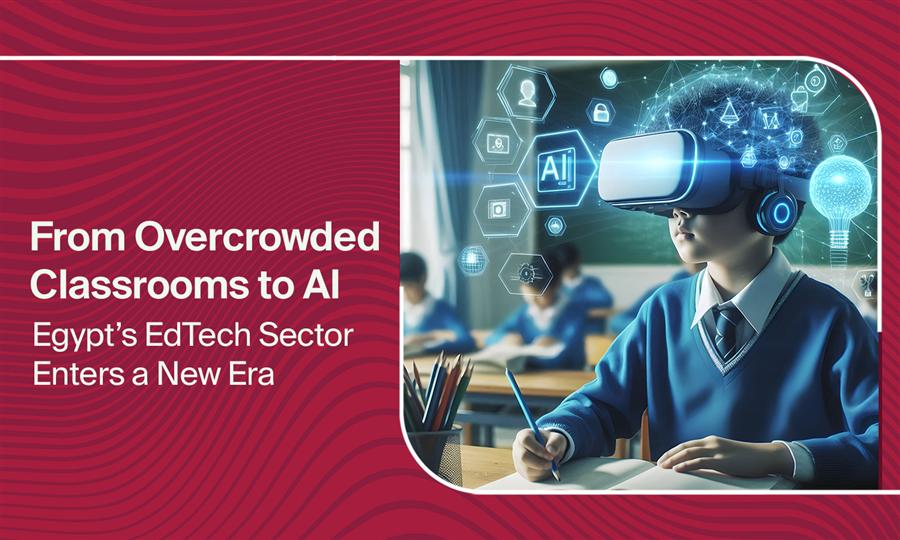
“Digital skills are no longer specialized skills; they are becoming foundational skills across almost every profession,” she says. “AI, data analysis, and digital collaboration tools are changing how businesses operate, regardless of sector. Graduates do not necessarily need to become AI engineers, but they must understand how to leverage AI responsibly to improve productivity, decision-making, communication, and problem-solving.”
Furthermore, ElGaby notes: “The future workforce will increasingly be valued not only for what they know but also for how effectively they use technology to perform their jobs. This means education institutions should integrate AI literacy and digital competencies across disciplines, enabling graduates to adapt as technologies continue to evolve.”
Labor Exports and Economic Value
Remittances from Egyptians abroad maintained strong momentum, jumping 31.2% year on year in the July–May period of fiscal year (FY) 2025/2026 to about $43.1 billion from roughly $32.8 billion in the same period of FY 2024/2025, according to the Central Bank of Egypt (CBE).
However, Hussein cautioned that labor mobility should focus on exporting skills rather than certificates. “I would describe this objective as developing skills-based international labor mobility, rather than simply increasing ‘labor exports.’ Egypt should seek to export verified skills and professional competencies, not merely academic certificates or large numbers of relatively low-paid workers.”
“This distinction matters because the economic value of labor mobility depends on workers’ productivity, wages, contractual protection, career progression and ability to transfer knowledge and savings back to the domestic economy,” he adds.
He urges destination-specific training tracks aligned with European and Gulf market standards, and the creation of a national digital skills passport to verify qualifications internationally. “Counting only the number of people who leave the country would reward volume rather than economic value.”
Specialized Universities as a Structural Solution
Egypt’s Ministry of Higher Education has confirmed the launch of new specialized universities in transport, food, and energy, developed in partnership with Germany’s TU Dresden and Japan’s Hiroshima University. The universities are scheduled to begin admitting students in the 2026/2027 academic year and are set to integrate engineering, economics, logistics, and applied sciences into sector-focused ecosystems.
“Specialized universities can support applied research and domestic industrial development,” Hussein says. Nevertheless, he cautions that governance and accountability will be critical.
To avoid duplication or obsolescence, he adds that “with the correct governance, however, it can become the connecting institution between national investment, technological change, applied research and workforce development.”
Egypt’s labor market is at a crossroads. While unemployment is falling, the skills mismatch remains acute. Economists and HR experts agree that bridging the gap requires continuous industry-academia collaboration, performance-based funding, and international skills partnerships. Without such reforms, Egypt risks producing graduates whose qualifications do not match the jobs available, limiting productivity gains and weakening the country’s competitiveness in global labor markets.
By Sarah Samir