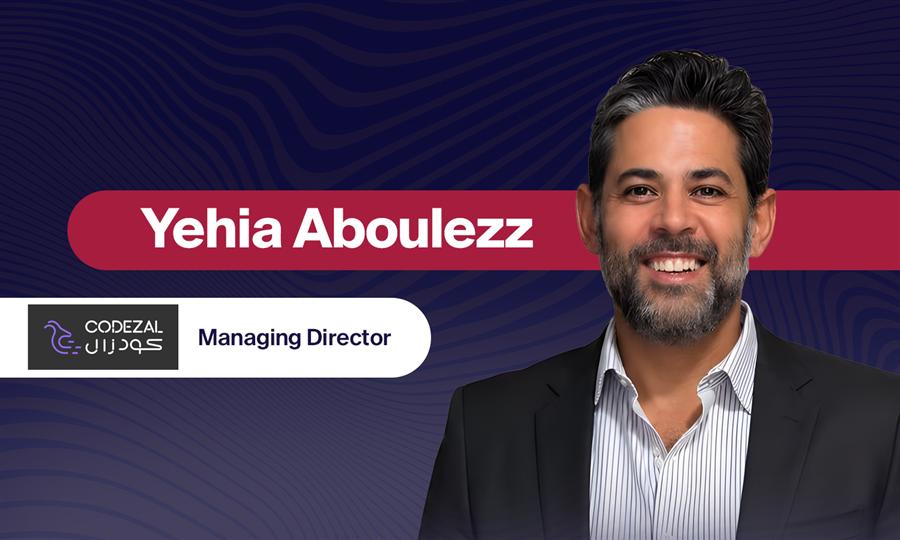
Arab Finance: As the Middle East accelerates its digital transformation, businesses across the region face a growing challenge: separating artificial intelligence hype from actual financial returns. Emerging as a critical bridge between technical engineering and corporate strategy is CodeZal AI, a specialized advisory and development firm focused on translating advanced machine learning models into tangible business outcomes.
In an exclusive interview with Arab Finance, Yehia AboulEzz, Managing Director of CodeZal AI, discusses the strategic importance of building C-suite AI literacy, navigating distinct macroeconomic priorities between Egypt and the GCC, and overcoming data infrastructure bottlenecks to safely unlock deep, ROI-driven technology across the MENA region.
1-How would you define CodeZal AI’s core proposition, and what commercial gap in the MENA region’s tech ecosystem did you set out to solve?
For 20 years, I have sat on both sides of the table. I started as an engineer, then moved to the commercial side for the last 15 years, selling and building high-tech products. Along the way, I learned one simple thing: companies rarely fail with technology because the technology is bad. They fail because nobody connected it to a real business problem.
That is the gap CodeZal fills. Right now, the region is drowning in AI noise. Every vendor has a demo that looks like magic, and every conference promises the future by next quarter. Meanwhile, the business leader is left with one quiet question that rarely gets answered: "What do I actually do with this, and will it make me money?"
CodeZal is the bridge between the boardroom and the code. We help leaders understand AI in plain language, find where it genuinely fits, then build it. We sell results. The region was never short on AI; it was short on people who could turn AI into money.
2-From a business leadership standpoint, why is establishing AI literacy at the C-suite level critical before writing a single line of code?
Because the most expensive AI mistakes do not happen in the code. They happen in the decision made right before the code is written.
I have seen this too many times. A leader hears a shiny buzzword, gets excited, and signs off on a big project that solves nothing. Or, on the other hand, they become cautious and freeze while the competition sprints past. Both come from the same place: they do not actually understand what they are buying.
I play chess. You never grab a piece before you have read the whole board; otherwise, you are just losing in style. AI works the same. If the C-suite does not understand the board, no engineer can win the game for them; they will just build a sophisticated solution to the wrong problem.
So, we start with the leaders. Half a day, plain language, real examples from their own industry. My test is simple: can I explain it so it clicks for someone who has never seen it?
Once leaders truly get what AI can and cannot do, every decision that follows gets cheaper and smarter. Education is not a nice-to-have for us; it is the cheapest insurance a company can buy before spending real money.
3-With your extensive background leading commercial tech strategies across the Levant, Egypt, and your heavy current footprint in Saudi Arabia, how do the operational AI priorities differ between Cairo and the GCC?
Technology may be the same, but the motivations are completely different.
In Cairo, the first question is almost always: "How does this save me money?" Margins are tight, and the currency keeps everyone on their toes, so companies need AI to earn their seats by cutting costs or helping the team increase productivity. Egyptian companies guard their cash like a goalkeeper. The main constraints are budget and infrastructure, never mind. Talents and world-class professionals are everywhere.
In the Gulf, especially Saudi Arabia, the first question is: "How does this help me lead?" AI is supported by serious money and a national push under Vision 2030. Saudi Arabia even crowned 2026 the Year of Artificial Intelligence. So the appetite is for speed, scale, and being first, not saving money. However, the constraints are different: capital and ambition are abundant, but the market is short on AI talent, and everyone's fishing in the same small pond.
So, in Egypt, I help clients squeeze every drop of value. In the Gulf, I help them scale fast without spinning off the track. One market is optimizing, the other is flat-out racing.
4- How can Egyptian tech talent and localized AI consultancies effectively plug into the high-value capital expenditure occurring in the Gulf Countries Council (GCC) market right now?
This is the most exciting corridor in the region right now, and a main reason why I packed up and built CodeZal in Saudi Arabia.
Saudi Arabia has both the capital and the ambition, plus a target for its AI sector to contribute nearly $20 billion to the economy by 2030. However, the Kingdom is short on AI talent. Meanwhile, Egypt happens to sit on one of the deepest pools of sharp, affordable engineers anywhere.
But here is the trap Egyptian talent has to dodge. They must avoid showing up as cheap hands for hire because it is a race to the bottom, and nobody wins it. Instead, they need to show up as a partner who gets the GCC ambition and can actually deliver on it. The how is simple; it is better to be on the ground, not on a screen, and respect that this is a Saudi-first vision, not an outsourcing bargain bin.
Also, Egyptian professionals need to learn the local rules and how business really gets done in the kingdom. Delivering outcomes, not headcount, to stop plugging into the spending and start shaping it, is exactly the seat we are building for CodeZal.
5- When CodeZal conducts an "AI Readiness Assessment" for an Egyptian corporate client, what are the most common infrastructure or data architecture bottlenecks you encounter, and how capable is Egypt's private sector of moving from legacy systems to advanced ML models?
In most cases, the bottleneck is not the AI; it is the data hiding underneath it. When we run a readiness assessment, the usual culprit is messy, scattered data. Customer info is spread across 10 spreadsheets, old systems that operate in isolation, and critical institutional knowledge frequently resides with individuals rather than within structured systems. You cannot put a brilliant model on a messy foundation.
The second culprit is legacy systems that were never built to share. The third is plain old trust because nobody is sure the numbers are even right.
Is Egypt's private sector ready to leap straight to advanced machine learning? For most companies, not yet, but that is not the bad news people assume. Many want the shiny robot, but almost nobody wants to clean out the data closet first. The funny part is, the closet is where the money's hiding. The biggest, fastest wins come from tidying the data and automating the boring, repetitive work, not from a fancy model. Once that groundwork is in place, you have already banked real savings and built the base. The clever models come later, and they actually work because the ground is solid. So I tell clients: do not dream about the rocket before you have poured the runway.
6-As the former Chief Commercial Officer of WideBot, how do you see the region evolving past basic conversational tools into deep, ROI-driven technologies like Agentic AI and predictive data pipelines?
I had a front-row seat to this at WideBot, so let me be straight about it.
The first wave of conversational AI was basically a polite answering machine: customer asks a question, bot answers. It was useful, but it only talks; it does not lift a finger. The next wave is AI that does the work instead of just chatting about it.
Agentic AI does not only tell you, "Where is my order?" It sorts the whole process out from start to finish. Predictive data pipelines go further; they whisper what is about to happen, so you move before the problem lands. A bank can spot customers who are at risk of leaving, while a factory can detect machines likely to break. That is where the real money sits, because now AI is earning or saving cash, not just answering FAQs.
But here is my operator's warning, free of charge: do not chase agentic just because it is the buzzword wearing the crown this year. It only pays off with a real use case and clean data behind it. Without that, your sophisticated "agent" is just a chatbot with a bigger invoice. The winners will not necessarily own the fanciest AI, but they will be the ones who aimed solid AI at a problem that genuinely mattered.
7-In a populous market like Egypt, the most profound macroeconomic fear surrounding AI is widespread labor displacement and job loss. How do you address this anxiety when speaking to business leaders, and how should corporate structures pivot to view AI as an operational multiplier rather than a human replacement?
I never wave this fear away because it is real, and people deserve a straight answer, not a sales pitch.
My view is that AI replaces tasks, not people, when you lead it right. Think about the dull, repetitive slice of your job, the part you would happily never do again. That is the part AI takes. What AI cannot replace are your judgment, relationships, and knack for handling the messy human moments. That is where you get more valuable, not less.
For 20 years, I have always believed that a company’s greatest asset is its people, and I have been lucky with my team. That is why I encourage not to use AI as a quiet back door to shrink your team and use it to rescue employees from the work nobody enjoys and move them up to the work that matters.
One good person with AI can now do what used to take five. That is not four people out the door; that is one team punching way above its weight. If organizations treat AI as a cheap replacement, they will win a single quarter, then watch their best people walk. On the other hand, treating AI as a multiplier for the team will deliver gains for years.
8- With Saudi Arabia enforcing its Personal Data Protection Law (PDPL) and Egypt strengthening its data regulations, how is CodeZal helping enterprises scale their AI capabilities without breaching strict local compliance frameworks?
The timing could not be better. Saudi Arabia’s PDPL has been fully enforceable since September 2024, and the regulator, the Saudi Data and Artificial Intelligence Authority (SDAIA), has already imposed fines.
In Egypt, enforcement accelerated after the executive regulations were issued in November 2025, and full enforcement begins on November 1st, 2026. In effect, Egyptian companies effectively have a countdown, whether they realize it or not.
A common misconception is that compliance is the enemy of AI. In reality, the opposite is true, as AI depends on data, and data rules are AI rules. Failing to comply not only puts you at risk of paying fines but also exposes you to the loss of customer trust.
At CodeZal, we embed compliance from day one rather than tacking it on later. We map the data you hold, where it resides, and what each law permits in each jurisdiction. While Egypt’s law is GDPR?inspired, Egypt and Saudi Arabia are not identical. We treat sensitive data, such as health information and biometrics, with additional safeguards, since both regimes protect it closely. Compliance is not like brakes to AI; it is the seatbelt that lets you accelerate safely.
9-How does CodeZal mathematically demonstrate the return on investment (ROI) or cost-efficiency gains of a 12-month AI roadmap to a skeptical Chief Financial Officer (CFO)?
A CFO is not persuaded by excitement; they are persuaded by numbers they can defend in a board meeting. Every line on a CodeZal roadmap has to answer one question: does this save money or make money, and how much? If I cannot put a number on it, it does not make the list.
From there, the ROI calculation is straightforward: the value generated minus the investment required, divided by the cost of implementation. A project that costs 100 and returns 300 is a number any CFO will happily carry to the board.
Two things turn a skeptic into a believer. The first is the payback period. We clearly demonstrate how many months until the investment pays for itself and prioritize the fastest, cheapest opportunities so they see proof early, before anyone bets big. The second is lowball on purpose. We would much rather promise 20% and deliver 30% than promise the moon and hand over a streetlight.
10-Looking ahead across the next three years, what is the strategic scaling roadmap for CodeZal AI? Which specific industrial verticals do you predict will fuel your next major phase of revenue growth across the MENA region?
I think about it in three moves, like building a team from nothing, which is the part I love most.
The first year is about trust. CodeZal earns its name in Saudi Arabia, the slow, honest way by delivering real results. We start with the workshops and the readiness work, then the first builds. You cannot scale trust you have not earned, and there is no shortcut around that.
The second year two is about the corridor. Once we have established a solid name, we scale across the GCC and sign the best engineering talent we can find, wherever it happens to be. Any good manager knows you do not win by being loyal to a postcode; you win by putting the right players in the right positions.
The third year three is about leverage. We take what has worked repeatedly and turn it into repeatable offerings, so we are not rebuilding the wheel for every client. That is when growth really starts to compound.
On verticals, financial services come first, with banks and fintechs, where the return on things like onboarding, fraud, and risk is massive, and it is close to home for me. Telecom comes second, given my old stomping ground for 15 years in AI fits. Then retail, and the giant government and public-sector push, which is enormous here under Vision 2030. The common thread is not the hype. It is wherever AI clearly saves or makes serious money. As any Zamalek fan will tell you, you do not win the league in your first season. You build the squad, you trust the plan, and the trophies follow.